Two numbers decide most of what a shipping box costs you, and neither of them is the price the box printer quotes. The first is dimensional weight, which is how carriers turn the size of your box into a billable weight whether or not the box is full. The second is board strength, the rating that determines whether your box arrives intact or arrives crushed with a damage claim attached. Spec these two well and a custom box saves money on every shipment; spec them badly and an attractive box quietly overpays on freight for its entire run. Here is how each one works and how to specify around it.
Dimensional weight: paying for the air inside
Carriers stopped charging by scale weight alone years ago, because a large, light package takes up truck space that a small heavy one does not. Their answer is dimensional weight: they compute a weight from the box’s size and bill you for whichever is greater, the actual weight or the dimensional weight. The formula is length times width times height in inches, divided by a fixed number the carrier calls a divisor, rounded up to the next whole pound.
For domestic ground and air, UPS and FedEx both use a divisor of 139. USPS applies dimensional weight to Priority Mail and Priority Mail Express, using a divisor of 166, and only on packages larger than one cubic foot, which is 1,728 cubic inches. A larger divisor is friendlier to the shipper because it produces a smaller dimensional weight, which is part of why an oversized box hurts more on UPS and FedEx than on USPS Priority.
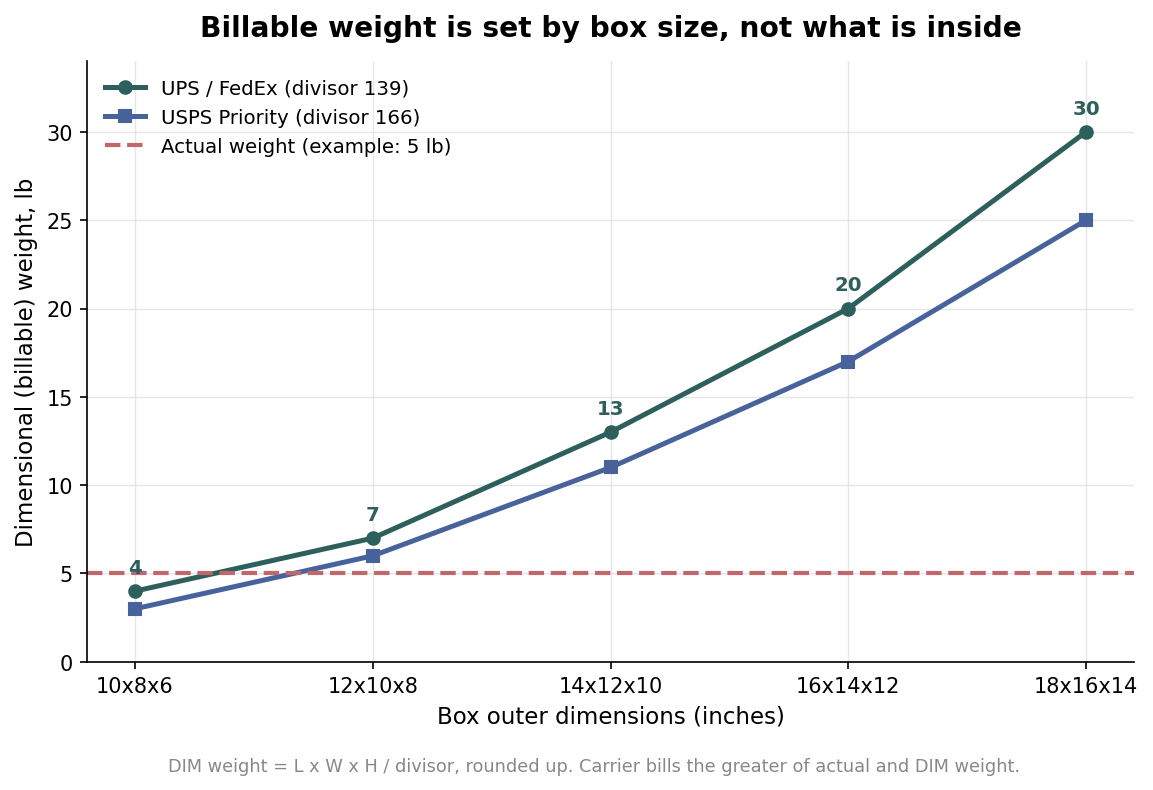
The chart makes the trap visible. A box that holds a five-pound product bills at five pounds only while it stays small. Push the outer dimensions up and the dimensional weight climbs past the actual weight, at which point every additional inch of empty box is billed as if it were product. This is why the cheapest-looking box, the slightly oversized one you already had on the shelf, is frequently the most expensive box to ship.
A worked example
Take a 16 by 12 by 10 inch box. That is 1,920 cubic inches. Divided by 139, the dimensional weight is 13.8 pounds, which rounds up to 14. If the packed box actually weighs six pounds on the scale, the carrier still bills you for 14 pounds, because dimensional weight is the greater figure. Drop the same product into a 12 by 10 by 6 inch box and the math changes to 720 cubic inches, a dimensional weight of about 5.2 pounds rounding to 6 — now the actual and billable weight are effectively the same, and you stop paying for empty space. Nothing about the product changed. Only the box did.
Board strength: ECT and Mullen ratings
The second number is structural. Corrugated board is rated two ways. The older Mullen, or burst, test measures the pressure a board can take before it ruptures, reported in pounds per square inch as figures like 200# or 275#. The newer Edge Crush Test, or ECT, measures how much top-to-bottom compression the board withstands on its edge, which is what actually matters when boxes are stacked on a pallet. ECT is reported as a plain number such as 32 or 44.
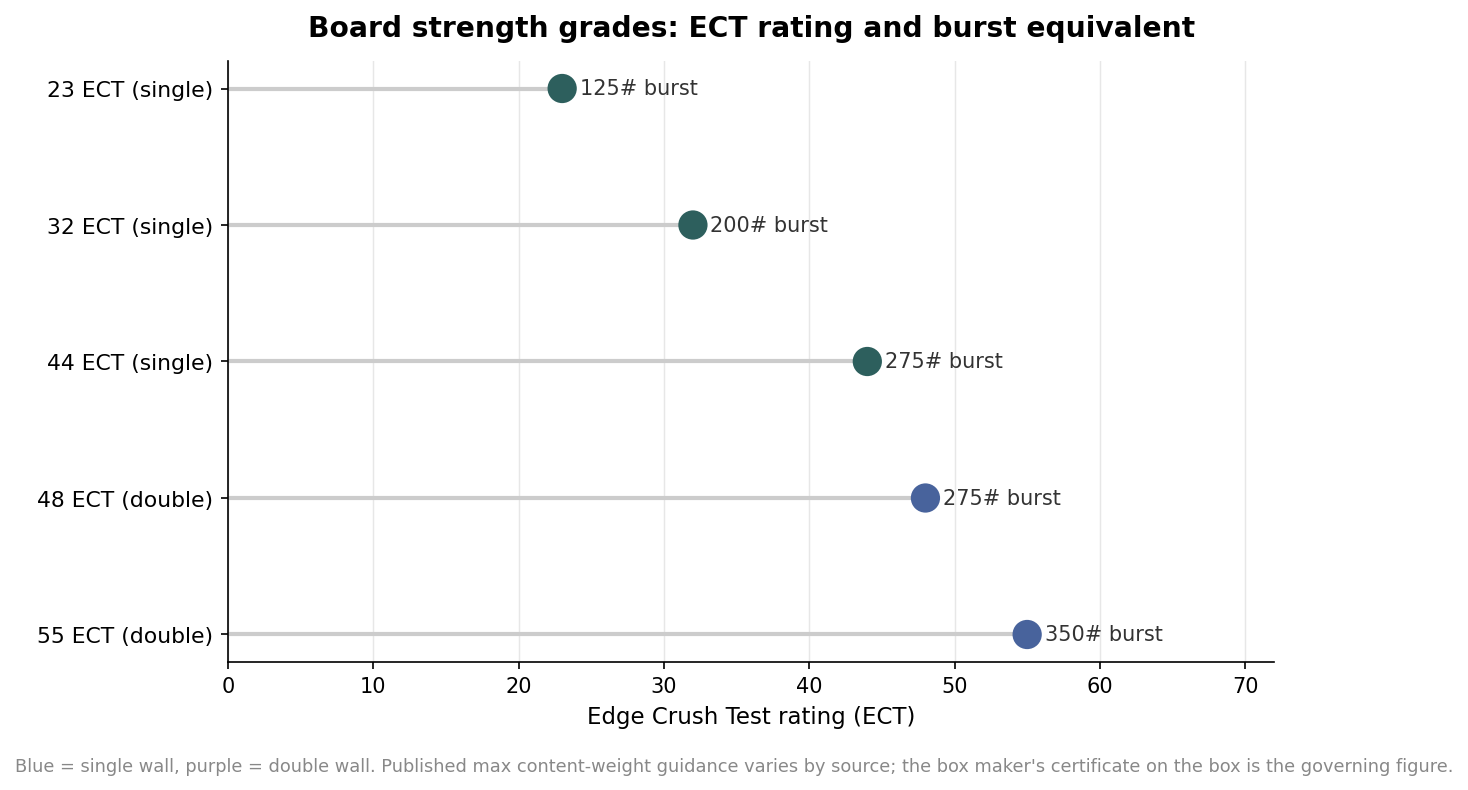
The two scales roughly track each other. A common single-wall board rates 32 ECT, equivalent to a 200# burst rating; a heavier single wall runs 44 ECT against a 275# burst; and double-wall constructions climb to 48 and 55 ECT for heavy or fragile loads. One honest caveat belongs here: published guidance for the maximum content weight of each grade varies noticeably between suppliers, because it depends on box size, stacking height, humidity, and how long the box sits in a warehouse. Treat any single weight figure as indicative. The number that actually governs is printed on the box itself.
Read the Box Maker’s Certificate
Look at the bottom flap of most stock corrugated boxes and you will find a round stamp called the Box Maker’s Certificate. It states which test the board meets, either a burst strength or an ECT rating, along with the maximum outer dimensions and the gross weight limit the box is certified to carry. That stamp is the manufacturer’s warranty of performance and the figure a carrier will point to in a damage dispute. When you specify a custom box, you are effectively specifying what that certificate will say, so decide the gross weight and stacking conditions first and let them drive the board grade, rather than choosing a grade by feel.
Specify in the right order
The sequence that keeps both numbers under control is straightforward. Start by right-sizing the box to the product with only enough clearance for protective material, because dimensional weight is the single biggest lever on recurring freight cost and every inch you remove is billed weight you stop paying. Then match the board grade to the packed gross weight and the way the boxes will be stacked, stepping up to a heavier single wall or a double wall only when the load or the stacking calls for it, since heavier board costs more per unit and adds a little of its own weight. Finally, confirm the Box Maker’s Certificate on the sample matches what you asked for before you approve a production run. Do those three in order and the box protects the product, satisfies the carrier, and stops overpaying for air on every parcel it ships.
Leave a Reply