Two custom boxes can look identical on a proof and behave completely differently on a loading dock, and the reason is usually buried in a single letter on the spec sheet: the flute. The flute is the wavy inner layer of corrugated board, and its profile quietly sets how much your box cushions, how well it prints, how flat it folds, and how much it costs. Get it right and the box protects the product and shows the artwork crisply; get it wrong and you are either paying for armor you do not need or shipping fragile goods in board that prints beautifully and crushes easily. This is a plain-language guide to the flute options so you can choose deliberately instead of accepting whatever the last order happened to use.
What a flute actually is
Corrugated board is a sandwich: flat outer liners glued to a fluted middle layer whose arches give the board its stiffness and shock absorption. Those arches are the flutes, and they are classified by letter according to how tall and how frequent they are. Taller, more widely spaced flutes trap more air and cushion more; shorter, tightly packed flutes make a thinner, smoother, flatter board that takes fine print well. The counterintuitive part is that the letters were assigned in the order the profiles were invented, not by size, which is why A-flute is thick and E- and F-flutes are thin even though they come later in the alphabet.
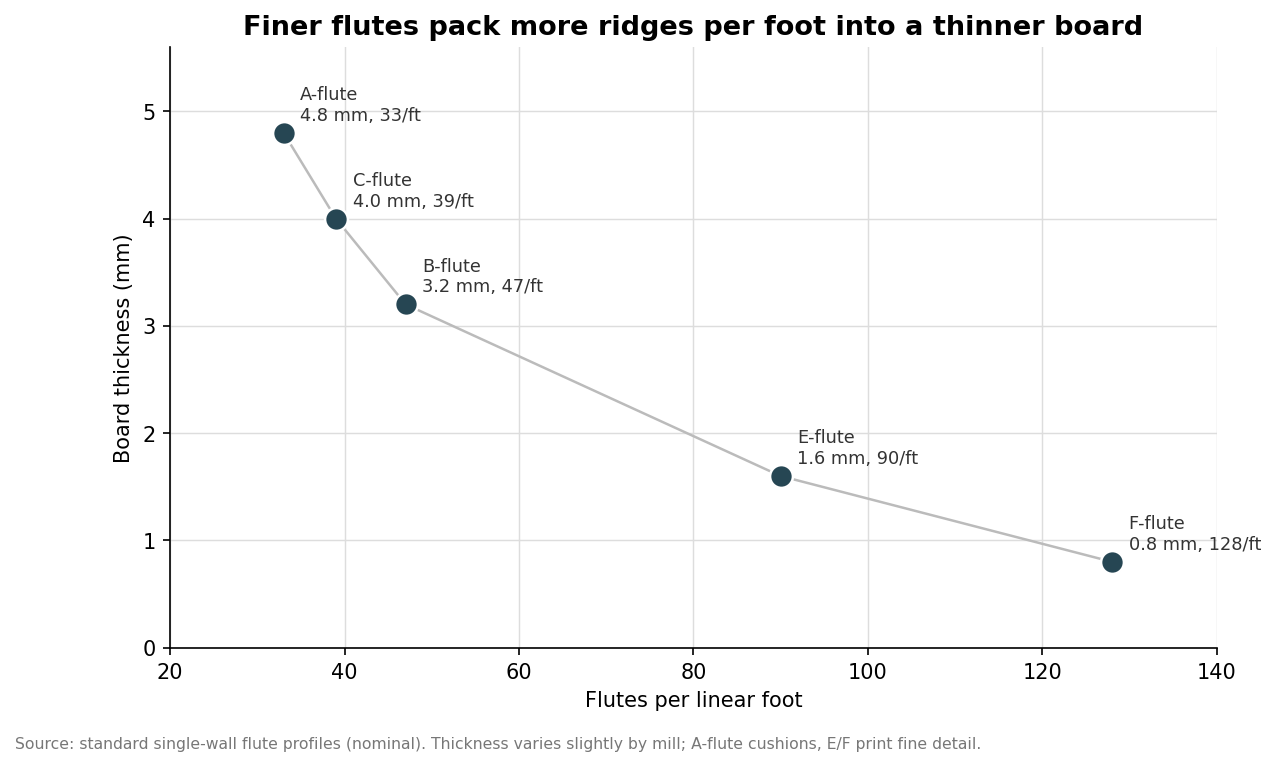
The single-wall lineup, from cushioning to print
A-flute is the tallest common profile at about 4.8 millimeters, with roughly 33 flutes per foot, and it delivers the most cushioning and stacking strength. It is the choice for fragile or heavy goods that need maximum protection. C-flute, around 4.0 millimeters and 39 flutes per foot, is the workhorse of general shipping; if you picture a standard brown shipping carton, you are almost certainly picturing C-flute, because it balances protection, stacking strength, and cost for e-commerce and product boxes.
B-flute, near 3.2 millimeters and 47 flutes per foot, trades some cushioning for a flatter, more rigid wall that resists crushing and prints more cleanly, which is why it suits canned goods, die-cut displays, and boxes where the graphics matter. E-flute steps down to about 1.6 millimeters and roughly 90 flutes per foot, giving a thin, smooth board that folds tidily and carries high-resolution print, making it the standard for retail-ready mailer boxes and cosmetics. F-flute, thinner still at around 0.8 millimeters and up to 128 flutes per foot, goes into small, print-forward retail packaging where every millimeter of shelf space counts. As a rule, move up the thickness scale for protection and down it for print fidelity and a compact fold.
When one wall isn’t enough: double-wall
For heavy contents, long supply chains, or anything that will be stacked high in a warehouse, a single wall may not carry the load, and the answer is double-wall board that glues two flute layers together. The most common combination is BC-flute, pairing B and C, which stacks the crush resistance of B with the cushioning of C for a noticeably tougher box. Heavier still are combinations like AC, and triple-wall board exists for industrial loads. Double-wall costs more and adds thickness, so it is not a default; it is what you reach for when the product weight or the shipping conditions genuinely demand it, and specifying it on light goods just adds cost and dimensional bulk.
Flute versus board grade: don’t confuse the two numbers
The flute letter is only half the strength story, and buyers often conflate it with the board’s grade. Grade is expressed either as an Edge Crush Test (ECT) value, which measures stacking strength, or as a Mullen burst rating in pounds, which measures resistance to puncture. A familiar single-wall grade is 32 ECT, roughly equivalent to a 200-pound Mullen board, commonly guided to about 65 pounds of gross contents. Step up to 44 ECT, near 275-pound burst, for heavier single-wall loads, and into double-wall grades such as 48 ECT and above when weights climb further. These weight figures are indicative ceilings for planning, not carrier rules, and real capacity depends on box dimensions and how the load is stacked.
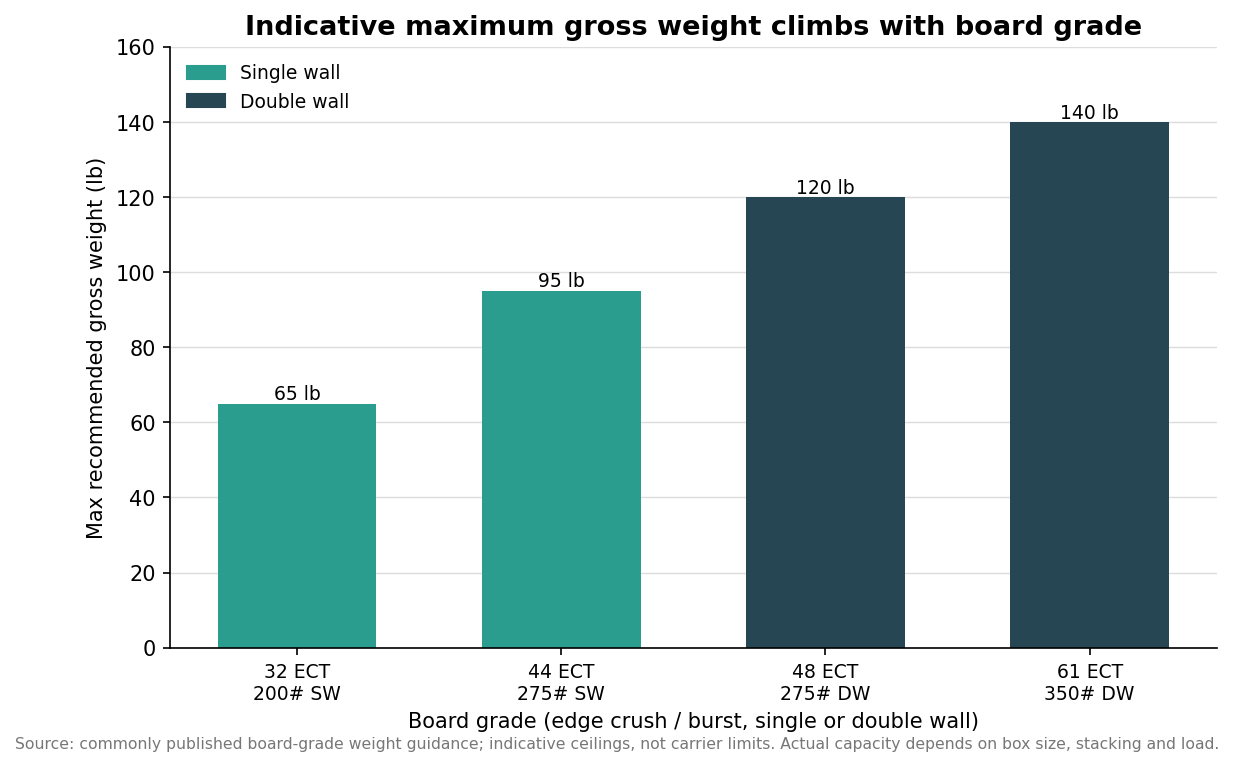
The practical point is that flute and grade are chosen together but for different reasons. Flute governs cushioning, printability, and how the box folds; grade governs how much weight it will bear and how high it can stack. A print-forward E-flute mailer and a heavy-duty double-wall shipper solve different problems, and a good spec names both the flute and the ECT or burst grade rather than assuming one implies the other.
Matching the flute to your product and your print
Start from the two things you actually care about: protecting the contents and presenting the brand. If the product is light and the box is the star of an unboxing, E-flute gives you a smooth, high-fidelity print surface and a crisp fold, which is why premium mailer boxes lean on it. If you are shipping a mix of general goods and want a dependable brown or lightly printed shipper, C-flute is the safe, economical default. If the contents are heavy, fragile, or bound for rough handling and tall stacking, move to B-flute for crush resistance, or to double-wall BC when a single wall will not carry the weight.
Whatever you land on, write the flute and the board grade into the specification alongside the dimensions and the print method, and if there is any doubt, order a small physical sample and, ideally, ship a test unit before committing to a full run. A flute that reads fine on paper can feel too flimsy or needlessly heavy once the real product is inside it. Choosing the profile on purpose, matched to the weight it must carry and the print it must show, is the difference between a box that merely arrives and one that protects the product and sells the brand at the same time.
Leave a Reply