Customized Shipping Boxes

Category: Uncategorized

  • Will Your Custom Shipping Box Pass? ISTA 3A, ECT Grades, and Amazon SIOC Explained

    Will Your Custom Shipping Box Pass? ISTA 3A, ECT Grades, and Amazon SIOC Explained

    A custom shipping box can look perfect on the design proof and still arrive crushed. The gap between the two is testing. Carriers, marketplaces, and your own warehouse each put a box through a different kind of abuse, and a box specified for one of them is not automatically ready for the others. Before you approve a board grade or sign off on a first run, it is worth knowing exactly what your box is being asked to survive and how the common benchmarks translate into numbers you can specify.

    The three tests your box actually has to pass

    Most shipping boxes are judged against three separate demands. The first is the trip itself: the drops, vibration, and stacking a parcel meets moving through a small-parcel network like UPS, FedEx, or a postal service. This is what the ISTA 3A protocol is built to simulate. The second is marketplace certification, most visibly Amazon’s Ships In Own Container and Frustration-Free Packaging programs, which lean on the ISTA 6-Amazon test suite. The third is static load: the weight of identical boxes stacked on top of each other on a pallet or in a warehouse rack, which comes down to board grade more than anything else. A box can be strong in one dimension and weak in another, so it helps to treat these as separate questions rather than a single pass or fail.

    Reading board grades: ECT versus Mullen

    Every corrugated box carries a strength rating, and there are two competing systems. The Edge Crush Test (ECT) measures how much top-to-bottom pressure the board can take before the walls buckle, which is the number that matters for stacking. The Mullen or burst test, written as a pound figure like 200#, measures resistance to a puncture or rupture, which matters more for rough single-package handling. The two are not directly convertible, but the industry treats certain grades as roughly equivalent for everyday use.

    As a working reference, a single-wall 32 ECT box, commonly treated as the equivalent of 200# Mullen, is generally rated for a gross weight in the neighborhood of 65 pounds per box. Stepping up to 44 ECT pushes that indicative capacity toward 95 pounds and improves stacking, and a double-wall 48 ECT box moves it to roughly 120 pounds for heavy or fragile goods. Treat these as starting points rather than guarantees: the real limit depends on flute profile, box dimensions, how the load is distributed inside, and humidity, which can strip a meaningful share of compression strength from any board over time.
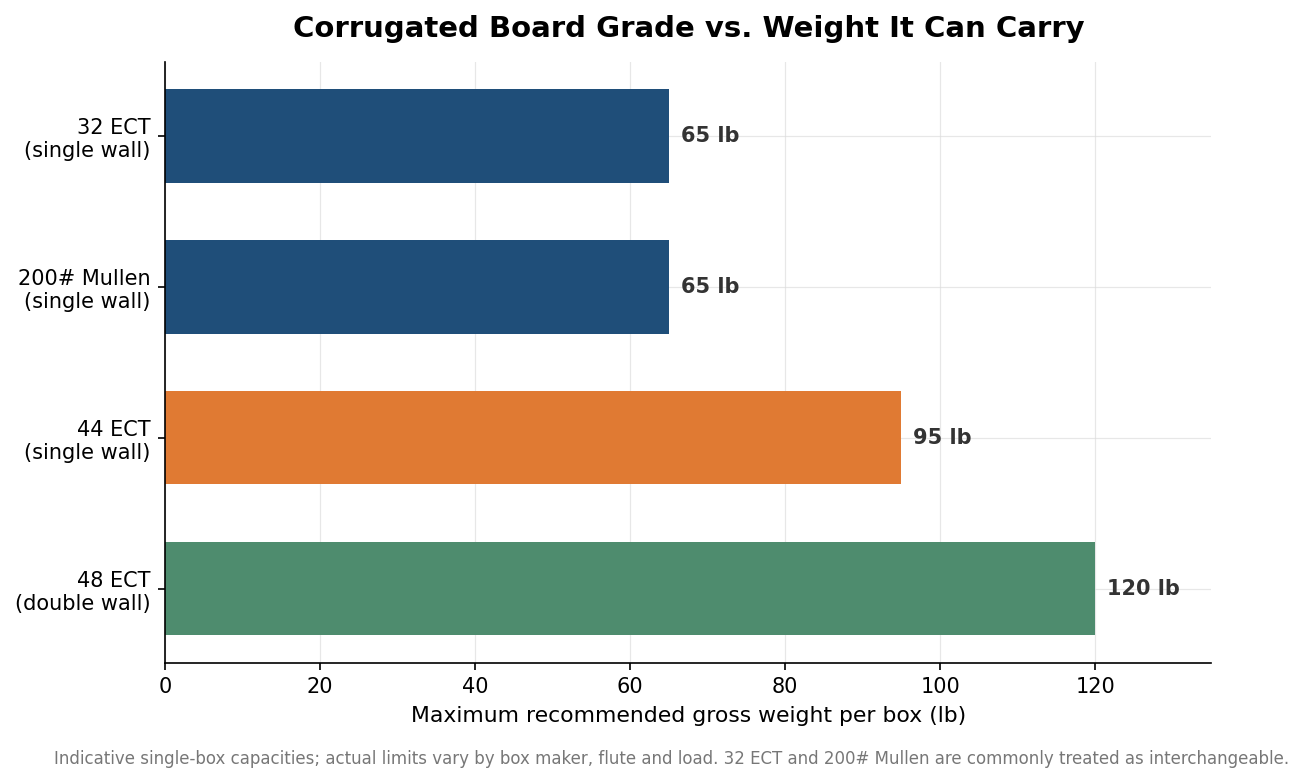
    Horizontal bar chart of maximum gross weight by corrugated board grade: 32 ECT and 200# Mullen 65 lb, 44 ECT 95 lb, 48 ECT double-wall 120 lb
    Indicative per-box weight capacity by board grade; actual limits vary with flute, size, load and humidity.

    For most e-commerce products under about 20 pounds, 32 ECT single-wall is the default and the cheapest sensible choice. The case for upgrading is not simply weight but stacking depth and travel distance. If your boxes will sit five or more layers high in a warehouse, ship internationally, or carry anything dense, the extra board usually costs less than the damage claims and reships it prevents.

    What ISTA 3A puts a parcel through

    ISTA 3A is the general simulation for individually packaged products weighing 150 pounds or less moving through a parcel network. It is not a single drop; it is a sequence of blocks. The package is first conditioned to a set temperature and humidity, then run through two drop sequences totaling roughly seventeen impacts whose heights scale with the package weight, so a light parcel is dropped from higher than a heavy one. Between and after those drops it faces random vibration profiles that stand in for hours on a truck bed, tested both with and without a top load pressing down.

    Layered on top are fixed hazard impacts that do not change with weight. Flat and elongated packages get a rotational edge drop from about 200 millimeters, and a concentrated or bridge impact where a hazard box is dropped from roughly 400 millimeters onto the package. Those two numbers, about 7.9 and 15.75 inches, are worth picturing because they represent the sharp, localized hits that expose weak corners and unsupported spans inside a box.
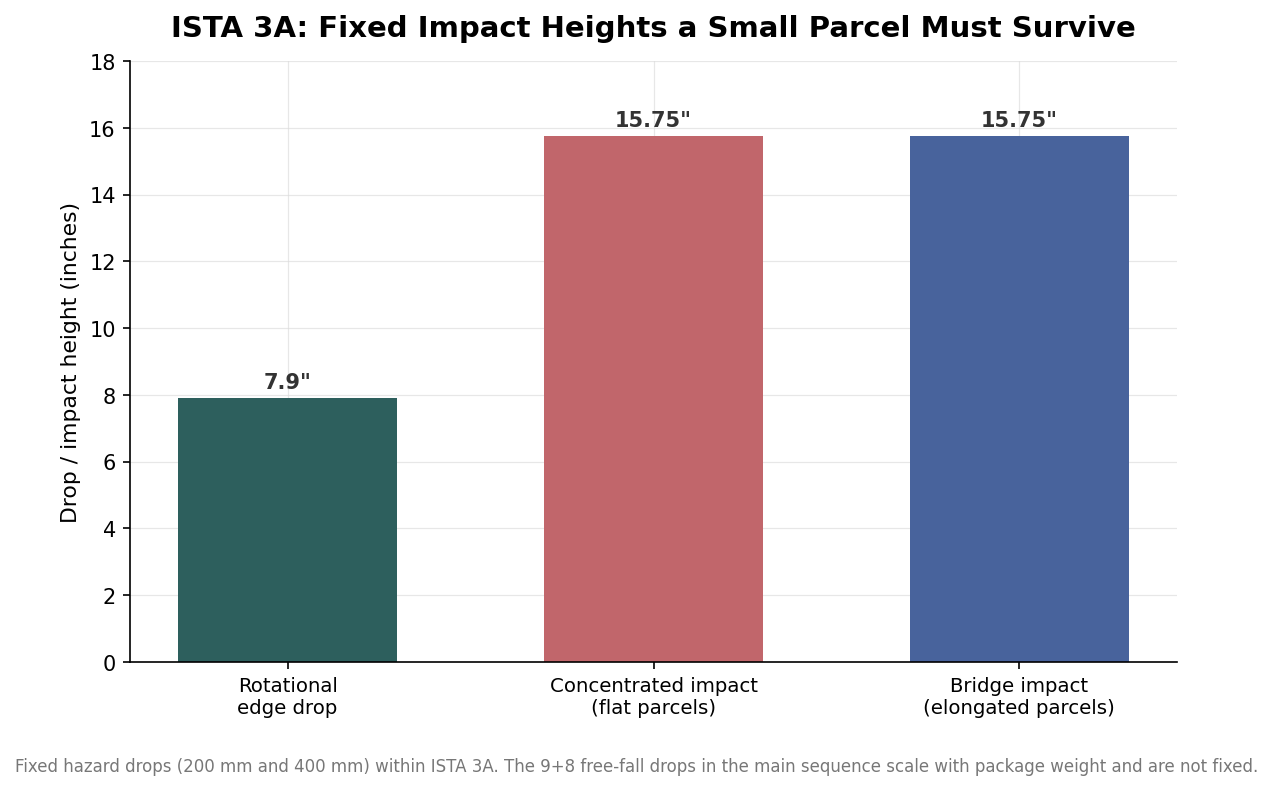
    Bar chart of ISTA 3A fixed impact heights: rotational edge drop 7.9 inches, concentrated and bridge impacts 15.75 inches
    The fixed hazard impacts inside an ISTA 3A run; the main drop sequence heights scale with package weight.

    The practical lesson from an ISTA 3A profile is that internal fit matters as much as the board. A product that slides, a void that lets contents shift, or a corner with no cushioning will fail vibration and edge-drop stages even in a strong box. Right-sizing the box to the product, and adding a molded insert or dunnage where the contents are fragile, does more for survivability than jumping a board grade.

    Amazon SIOC and Frustration-Free Packaging

    If you sell on Amazon, the box is doing double duty as the shipper. The Ships In Own Container (SIOC) and Frustration-Free Packaging (FFP) programs let a product ship in its own branded box with no additional Amazon overbox, which cuts material and dimensional-weight cost, but the box has to earn it by passing ISTA 6-Amazon testing. Packages generally need to clear a minimum footprint of about 9 inches long by 6 inches wide by 0.375 inches high to qualify. The testing burden scales with fragility: a product deemed non-fragile can certify on a single tested sample, while anything containing glass, other easily broken materials, or liquids is treated as fragile and requires five samples of each format to pass.

    The reason this is worth planning for early is that certification shapes your artwork and structure, not just your board. A SIOC box carries shipping labels directly, so the design has to leave clean label real estate, survive tape and scanning, and hold up without the protection of a second carton. Designing for it after the fact usually means a reprint.

    How to specify a box that passes the first time

    Start from the heaviest and most fragile item the box will carry, not the average one, and pick a board grade with headroom above that gross weight rather than right at the rated limit. Match the internal dimensions to the product so there is little void to fill, then decide cushioning based on how the contents behave under vibration rather than how they look on a bench. If a marketplace program is in your future, design the artwork around label space and certification from the first proof. And where you can, ask your box maker for the box maker’s certificate printed on the flap and, for anything headed into a marketplace or a demanding retail channel, a documented ISTA result rather than a verbal assurance. Those figures are indicative until your specific product is tested, but specifying against them from the start is what keeps a good-looking box from becoming a damaged one.
  • Corrugated Flute Types Explained: Choosing E, B, C, or Double-Wall for Custom Boxes

    Corrugated Flute Types Explained: Choosing E, B, C, or Double-Wall for Custom Boxes

    Two custom boxes can look identical on a proof and behave completely differently on a loading dock, and the reason is usually buried in a single letter on the spec sheet: the flute. The flute is the wavy inner layer of corrugated board, and its profile quietly sets how much your box cushions, how well it prints, how flat it folds, and how much it costs. Get it right and the box protects the product and shows the artwork crisply; get it wrong and you are either paying for armor you do not need or shipping fragile goods in board that prints beautifully and crushes easily. This is a plain-language guide to the flute options so you can choose deliberately instead of accepting whatever the last order happened to use.

    What a flute actually is

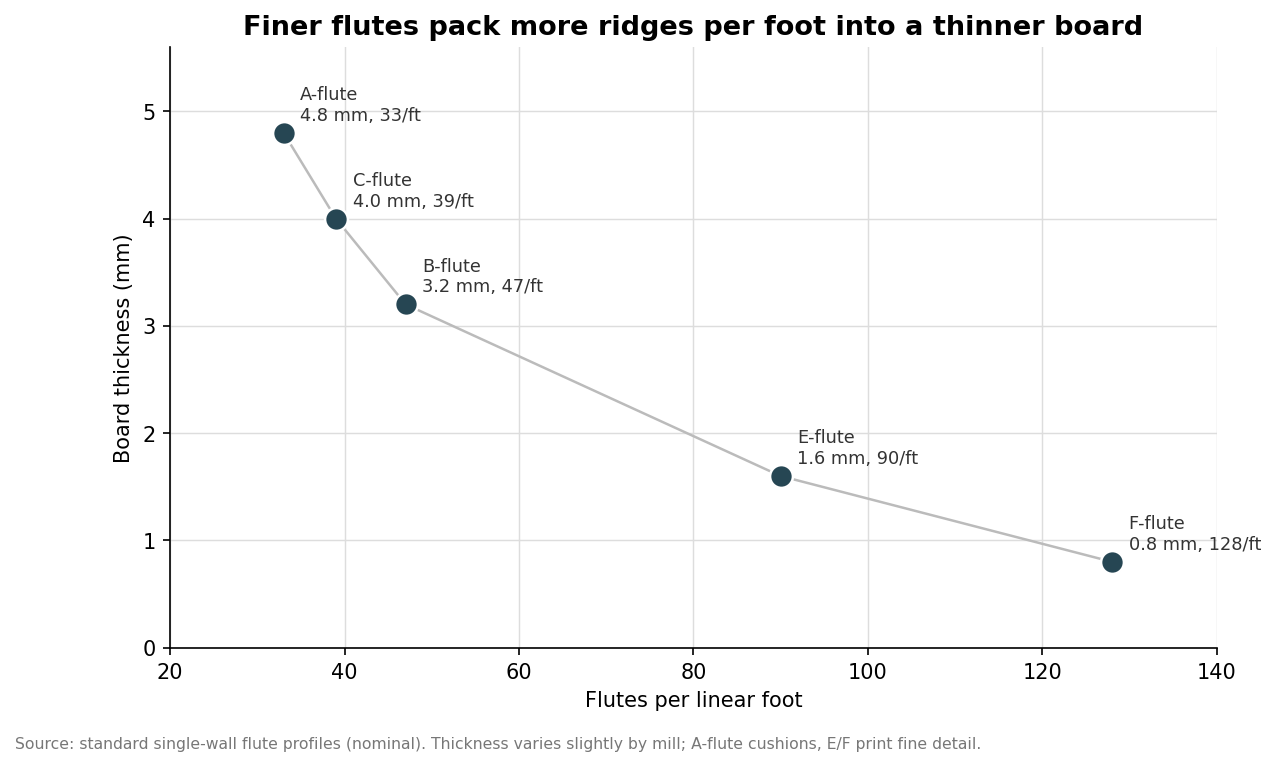
    Corrugated board is a sandwich: flat outer liners glued to a fluted middle layer whose arches give the board its stiffness and shock absorption. Those arches are the flutes, and they are classified by letter according to how tall and how frequent they are. Taller, more widely spaced flutes trap more air and cushion more; shorter, tightly packed flutes make a thinner, smoother, flatter board that takes fine print well. The counterintuitive part is that the letters were assigned in the order the profiles were invented, not by size, which is why A-flute is thick and E- and F-flutes are thin even though they come later in the alphabet.

    Scatter chart plotting flutes per linear foot against board thickness for A, C, B, E and F corrugated flute profiles
    Thicker flutes cushion more; finer flutes pack more ridges per foot and print sharper.

    The single-wall lineup, from cushioning to print

    A-flute is the tallest common profile at about 4.8 millimeters, with roughly 33 flutes per foot, and it delivers the most cushioning and stacking strength. It is the choice for fragile or heavy goods that need maximum protection. C-flute, around 4.0 millimeters and 39 flutes per foot, is the workhorse of general shipping; if you picture a standard brown shipping carton, you are almost certainly picturing C-flute, because it balances protection, stacking strength, and cost for e-commerce and product boxes.

    B-flute, near 3.2 millimeters and 47 flutes per foot, trades some cushioning for a flatter, more rigid wall that resists crushing and prints more cleanly, which is why it suits canned goods, die-cut displays, and boxes where the graphics matter. E-flute steps down to about 1.6 millimeters and roughly 90 flutes per foot, giving a thin, smooth board that folds tidily and carries high-resolution print, making it the standard for retail-ready mailer boxes and cosmetics. F-flute, thinner still at around 0.8 millimeters and up to 128 flutes per foot, goes into small, print-forward retail packaging where every millimeter of shelf space counts. As a rule, move up the thickness scale for protection and down it for print fidelity and a compact fold.

    When one wall isn’t enough: double-wall

    For heavy contents, long supply chains, or anything that will be stacked high in a warehouse, a single wall may not carry the load, and the answer is double-wall board that glues two flute layers together. The most common combination is BC-flute, pairing B and C, which stacks the crush resistance of B with the cushioning of C for a noticeably tougher box. Heavier still are combinations like AC, and triple-wall board exists for industrial loads. Double-wall costs more and adds thickness, so it is not a default; it is what you reach for when the product weight or the shipping conditions genuinely demand it, and specifying it on light goods just adds cost and dimensional bulk.

    Flute versus board grade: don’t confuse the two numbers

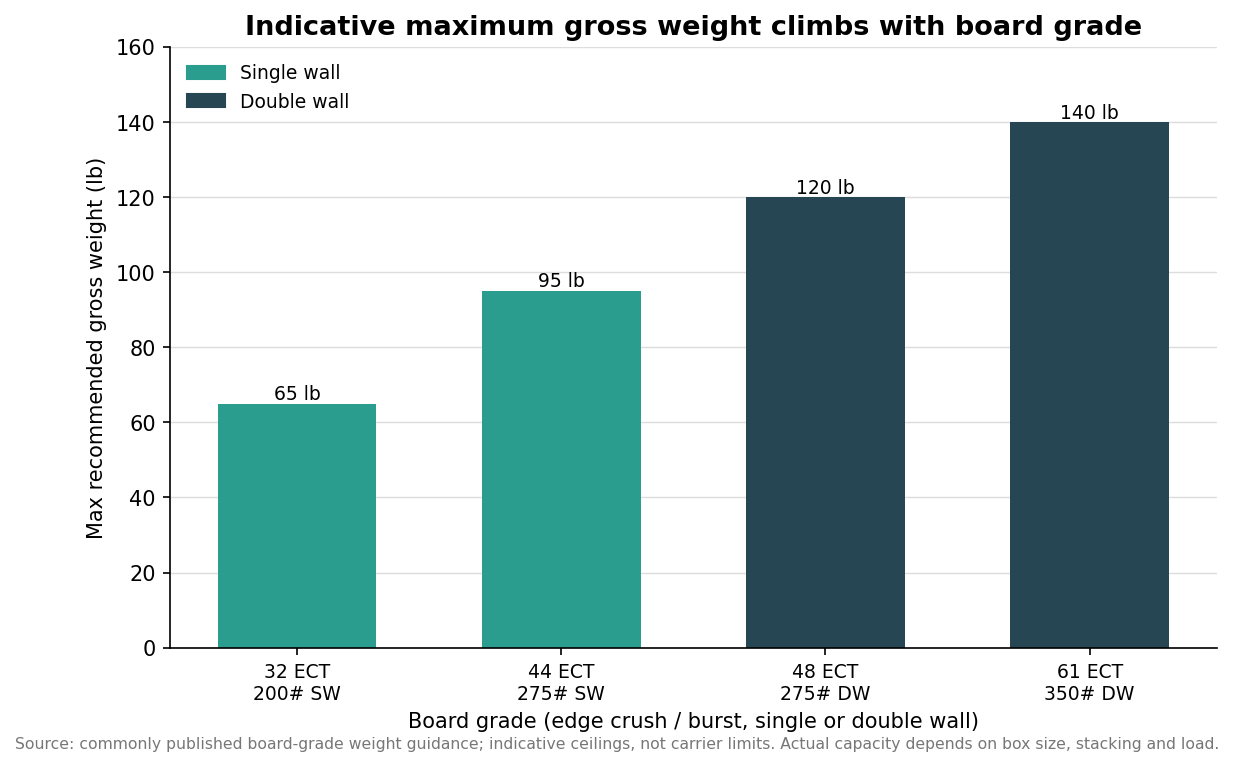
    The flute letter is only half the strength story, and buyers often conflate it with the board’s grade. Grade is expressed either as an Edge Crush Test (ECT) value, which measures stacking strength, or as a Mullen burst rating in pounds, which measures resistance to puncture. A familiar single-wall grade is 32 ECT, roughly equivalent to a 200-pound Mullen board, commonly guided to about 65 pounds of gross contents. Step up to 44 ECT, near 275-pound burst, for heavier single-wall loads, and into double-wall grades such as 48 ECT and above when weights climb further. These weight figures are indicative ceilings for planning, not carrier rules, and real capacity depends on box dimensions and how the load is stacked.

    Bar chart of indicative maximum gross weight by corrugated board grade for single-wall and double-wall boxes
    Board grade, not just flute, sets how much weight a box can carry; figures are indicative ceilings.

    The practical point is that flute and grade are chosen together but for different reasons. Flute governs cushioning, printability, and how the box folds; grade governs how much weight it will bear and how high it can stack. A print-forward E-flute mailer and a heavy-duty double-wall shipper solve different problems, and a good spec names both the flute and the ECT or burst grade rather than assuming one implies the other.

    Matching the flute to your product and your print

    Start from the two things you actually care about: protecting the contents and presenting the brand. If the product is light and the box is the star of an unboxing, E-flute gives you a smooth, high-fidelity print surface and a crisp fold, which is why premium mailer boxes lean on it. If you are shipping a mix of general goods and want a dependable brown or lightly printed shipper, C-flute is the safe, economical default. If the contents are heavy, fragile, or bound for rough handling and tall stacking, move to B-flute for crush resistance, or to double-wall BC when a single wall will not carry the weight.

    Whatever you land on, write the flute and the board grade into the specification alongside the dimensions and the print method, and if there is any doubt, order a small physical sample and, ideally, ship a test unit before committing to a full run. A flute that reads fine on paper can feel too flimsy or needlessly heavy once the real product is inside it. Choosing the profile on purpose, matched to the weight it must carry and the print it must show, is the difference between a box that merely arrives and one that protects the product and sells the brand at the same time.

  • How Much Do Custom Shipping Boxes Cost in 2026? Price Bands That Hold Up

    How Much Do Custom Shipping Boxes Cost in 2026? Price Bands That Hold Up

    Ask five packaging suppliers what a custom box costs and you will get five ranges, all of them true. The honest answer is that a printed corrugated mailer in 2026 lands anywhere from about ten cents to over four dollars per unit, and where you fall in that band is decided by a handful of levers you control: quantity, size, board grade, print method, and finish. This piece puts real published numbers on each lever so you can walk into a quote conversation knowing roughly what you should pay, instead of finding out afterward what you should have paid.

    The headline bands, before anything else

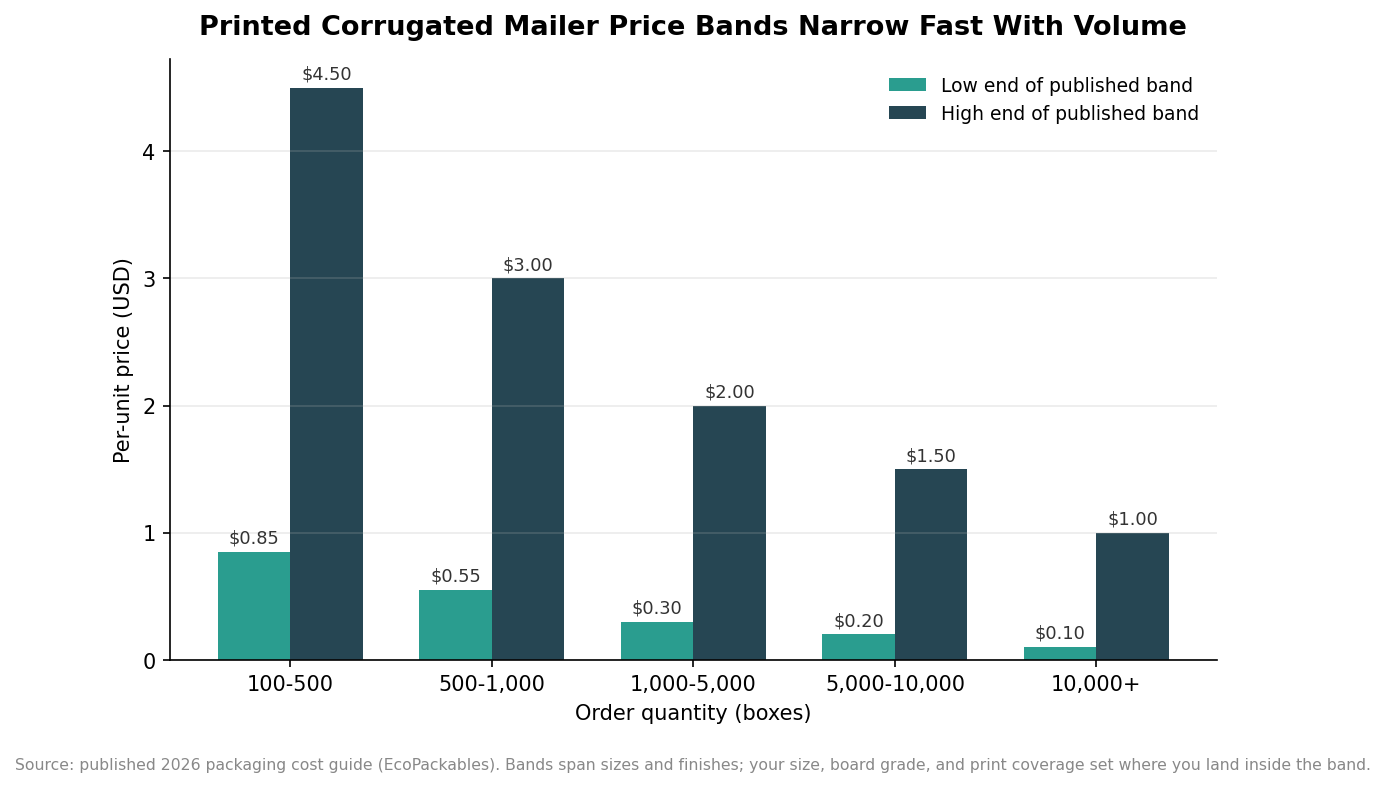
    Published 2026 cost guides from US packaging suppliers converge on similar territory. Standard kraft or plain cardboard mailers run about $0.40 to $1.50 per unit in bulk, with premium fully customized boxes at $2 to $5 and up. Corrugated shipping mailers as a category are quoted at roughly $1 to $4 per box in the general case, while rigid gift-style boxes jump to $4 to $15 or more, which is why e-commerce brands rarely ship in them. Within corrugated, the published per-unit bands by volume tell the real story: roughly $0.85 to $4.50 at 100 to 500 units, $0.55 to $3.00 at 500 to 1,000, $0.30 to $2.00 at 1,000 to 5,000, $0.20 to $1.50 at 5,000 to 10,000, and $0.10 to $1.00 above 10,000. These are bands, not points, because a small kraft mailer with one print color and a large full-coverage two-side print sit at opposite walls of the same tier.

    Grouped bar chart of published low and high per-unit prices for printed corrugated mailers across five order-quantity tiers, from 100-500 units to over 10,000
    Published 2026 price bands for printed corrugated mailers: both walls of the band fall as quantity rises, steeply at first.

    Quantity is the biggest lever, and it flattens

    Read the tiers again and notice the shape: unit price falls by roughly half between the first tier and the 1,000-to-5,000 tier, then the savings per additional thousand shrink. The economics behind that are simple. Setup, plates, and machine make-ready are fixed costs spread across the run, and corrugator time gets cheaper per sheet at volume; once those fixed costs are diluted, you are mostly paying for board, and board scales linearly. The practical takeaway for a growing brand is to buy at the tier where the curve flattens for your size, typically 1,000 to 5,000 units, rather than pre-buying a year of stock to chase the last dime. Boxes are bulky to store, and a packaging redesign or a size change can strand a pallet of obsolete inventory that ate your discount.

    What printing actually adds

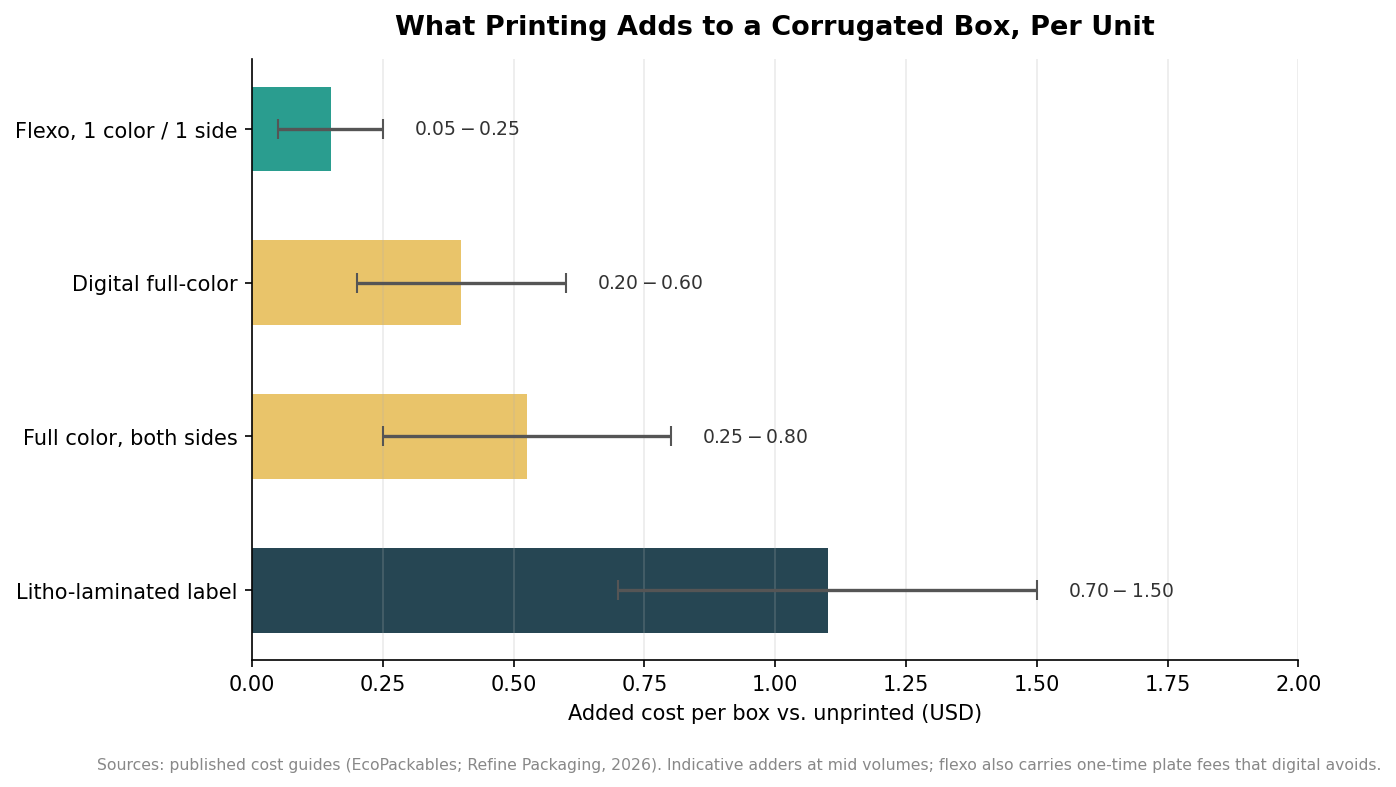
    Printing is quoted as an adder on top of the plain box, and the published figures are more modest than most buyers expect. A single color flexographic print on one side, the classic logo-on-kraft look, adds about $0.05 to $0.25 per unit. Full-color digital print adds roughly $0.20 to $0.60. Going full color on both inside and outside pushes the adder to about $0.25 to $0.80. The premium route, a litho-printed label laminated to the corrugated board for photographic quality, adds $0.70 to $1.50 per unit and is the only method here that can double a cheap box’s cost by itself.

    Horizontal bar chart with range whiskers showing per-unit cost added by four printing methods, from five cents for one-color flexo to $1.50 for litho-laminated labels
    What printing adds per box: one-color flexo is nearly free at volume, while litho lamination is a premium finish with a premium adder.

    The method choice is really a quantity decision. Digital has no plates, so its unit adder is flat from the first box, which makes it the default under roughly a thousand units and for multi-design runs. Flexo carries one-time plate charges, published anywhere from $50 to $150 per color for simple stock-size work up to around $1,000 per plate for complex dedicated tooling, but its per-unit run cost is the lowest of any method, so it wins long runs of a stable design. If you print the same box all year, flexo plates amortize to pennies; if you change artwork quarterly, digital’s zero-setup economics usually beat flexo’s cheaper ink.

    Setup fees, minimums, and lead times

    Three quote-sheet lines deserve as much attention as unit price. First, tooling: beyond print plates, a custom die-cut shape needs a cutting die, another one-time charge, which is why sticking to a supplier’s existing die library for standard mailer sizes saves real money on small runs. Second, minimums: custom-printed work on stock sizes commonly starts at 500 to 1,000 units at traditional converters, while digital-first online suppliers advertise minimums down to low double digits or none at all, at a correspondingly higher unit price. Third, time: published production timelines run about 8 to 10 business days after proof approval, but the full cycle including sampling, revisions, and freight is realistically three to ten weeks, and overseas production sits at the long end. If your launch date is fixed, the calendar is part of the price, and rush surcharges or air freight can erase a per-unit saving overnight.

    Getting to the low wall of your band

    You cannot choose your price, but you can choose which wall of the band you sit against. Size down honestly: board is priced by area, and the dimensional-weight math covered elsewhere on this site means an oversized box costs you twice, once at the converter and again at the carrier. Keep the board grade proportionate to the product; a 32 ECT single-wall mailer handles most e-commerce parcels, and specifying heavier board than the product needs is the most common silent overspend. Print one color on kraft unless the unboxing is genuinely part of your marketing, in which case spend the digital adder on the outside and leave the inside plain. Quote the same spec at two quantity tiers and at two suppliers, one digital-first and one traditional, because the crossover between them depends on your exact artwork and volume. And treat every number in this piece as indicative: resin, linerboard, and freight indexes move year to year, and a published band is a map, not a quote. The map is enough to know when a quote is fair, and that is the negotiating position that actually saves money.

  • What Really Drives Shipping Box Cost: Dimensional Weight and Board Strength

    What Really Drives Shipping Box Cost: Dimensional Weight and Board Strength

    Two numbers decide most of what a shipping box costs you, and neither of them is the price the box printer quotes. The first is dimensional weight, which is how carriers turn the size of your box into a billable weight whether or not the box is full. The second is board strength, the rating that determines whether your box arrives intact or arrives crushed with a damage claim attached. Spec these two well and a custom box saves money on every shipment; spec them badly and an attractive box quietly overpays on freight for its entire run. Here is how each one works and how to specify around it.

    Dimensional weight: paying for the air inside

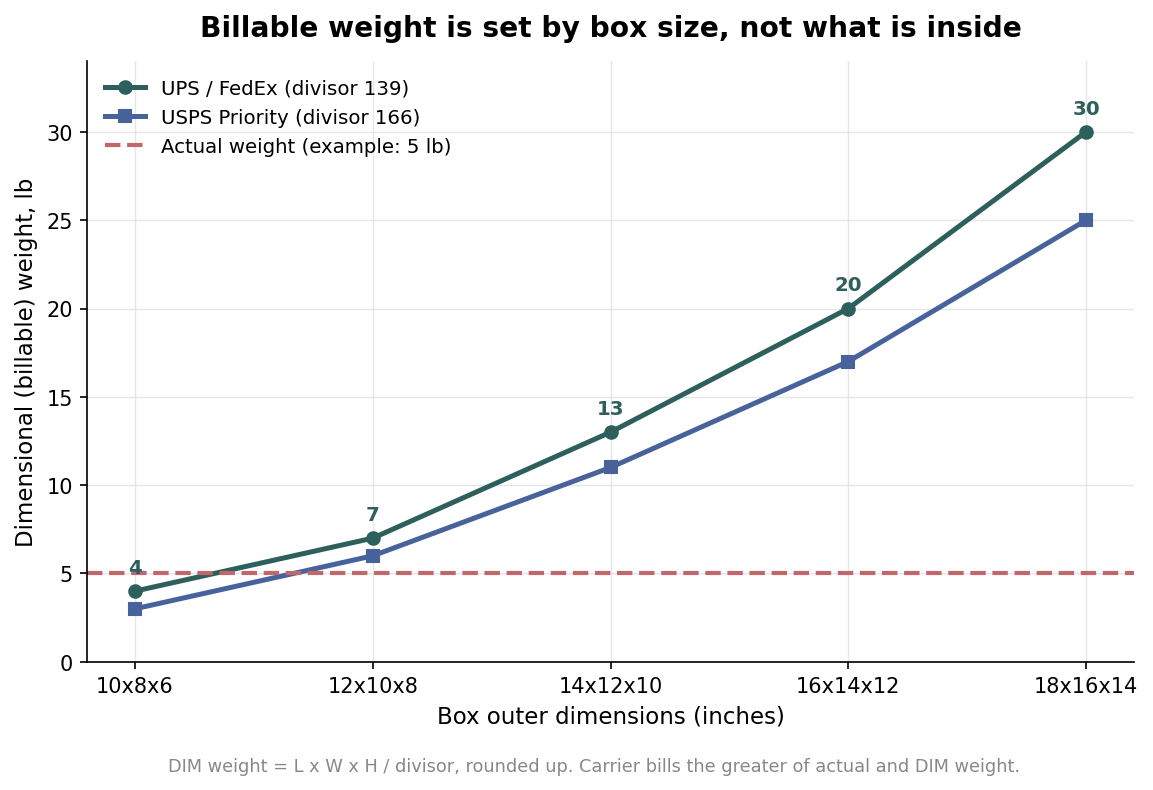
    Carriers stopped charging by scale weight alone years ago, because a large, light package takes up truck space that a small heavy one does not. Their answer is dimensional weight: they compute a weight from the box’s size and bill you for whichever is greater, the actual weight or the dimensional weight. The formula is length times width times height in inches, divided by a fixed number the carrier calls a divisor, rounded up to the next whole pound.

    For domestic ground and air, UPS and FedEx both use a divisor of 139. USPS applies dimensional weight to Priority Mail and Priority Mail Express, using a divisor of 166, and only on packages larger than one cubic foot, which is 1,728 cubic inches. A larger divisor is friendlier to the shipper because it produces a smaller dimensional weight, which is part of why an oversized box hurts more on UPS and FedEx than on USPS Priority.

    Line chart showing dimensional weight rising with box size for divisor 139 and 166 versus a flat 5-pound actual weight line
    Dimensional weight climbs with box size and overtakes actual weight, so oversized boxes bill for empty space.

    The chart makes the trap visible. A box that holds a five-pound product bills at five pounds only while it stays small. Push the outer dimensions up and the dimensional weight climbs past the actual weight, at which point every additional inch of empty box is billed as if it were product. This is why the cheapest-looking box, the slightly oversized one you already had on the shelf, is frequently the most expensive box to ship.

    A worked example

    Take a 16 by 12 by 10 inch box. That is 1,920 cubic inches. Divided by 139, the dimensional weight is 13.8 pounds, which rounds up to 14. If the packed box actually weighs six pounds on the scale, the carrier still bills you for 14 pounds, because dimensional weight is the greater figure. Drop the same product into a 12 by 10 by 6 inch box and the math changes to 720 cubic inches, a dimensional weight of about 5.2 pounds rounding to 6 — now the actual and billable weight are effectively the same, and you stop paying for empty space. Nothing about the product changed. Only the box did.

    Board strength: ECT and Mullen ratings

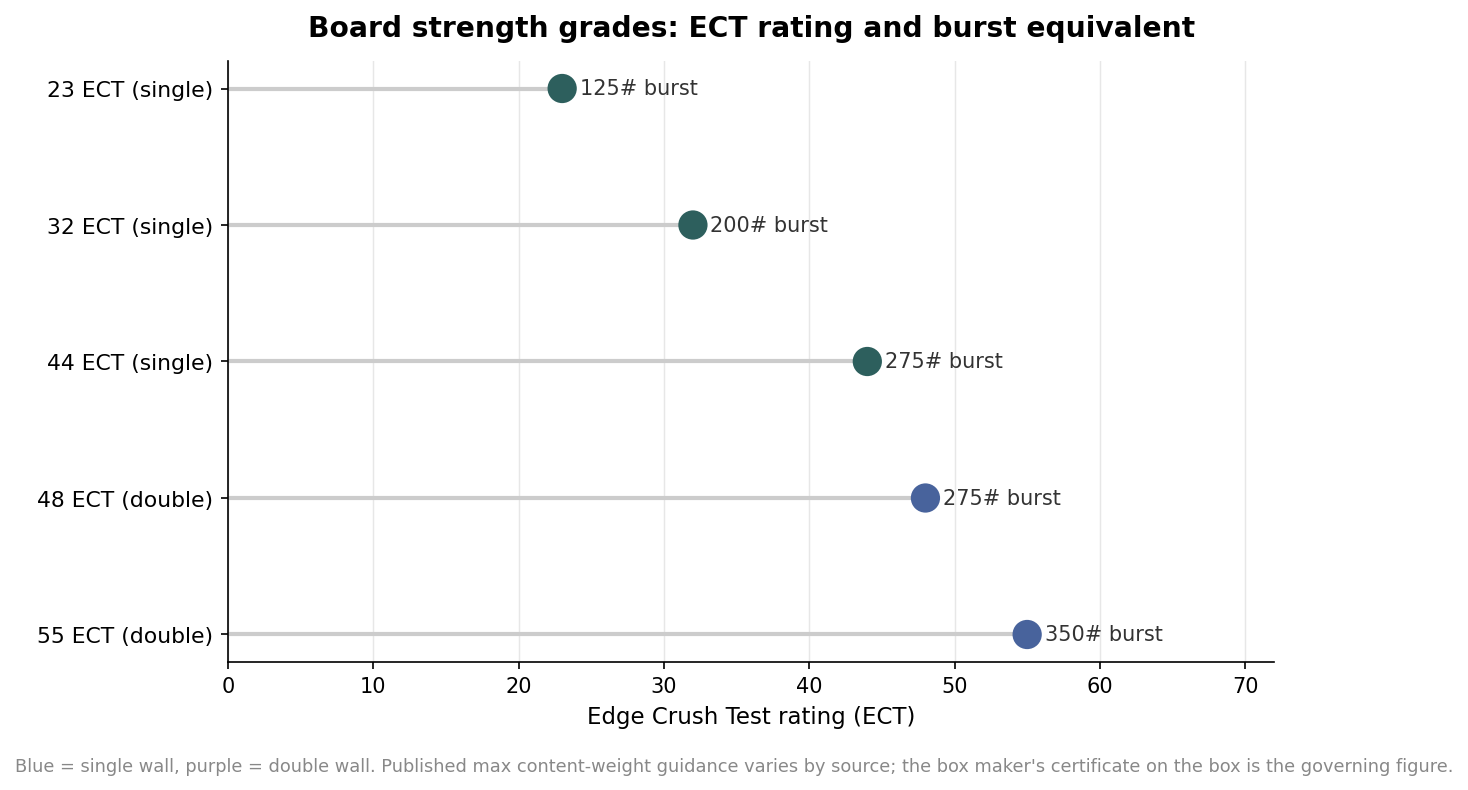
    The second number is structural. Corrugated board is rated two ways. The older Mullen, or burst, test measures the pressure a board can take before it ruptures, reported in pounds per square inch as figures like 200# or 275#. The newer Edge Crush Test, or ECT, measures how much top-to-bottom compression the board withstands on its edge, which is what actually matters when boxes are stacked on a pallet. ECT is reported as a plain number such as 32 or 44.

    Lollipop chart mapping corrugated ECT ratings 23 to 55 to their Mullen burst equivalents from 125# to 350#
    ECT ratings and their Mullen burst equivalents across single- and double-wall board grades.

    The two scales roughly track each other. A common single-wall board rates 32 ECT, equivalent to a 200# burst rating; a heavier single wall runs 44 ECT against a 275# burst; and double-wall constructions climb to 48 and 55 ECT for heavy or fragile loads. One honest caveat belongs here: published guidance for the maximum content weight of each grade varies noticeably between suppliers, because it depends on box size, stacking height, humidity, and how long the box sits in a warehouse. Treat any single weight figure as indicative. The number that actually governs is printed on the box itself.

    Read the Box Maker’s Certificate

    Look at the bottom flap of most stock corrugated boxes and you will find a round stamp called the Box Maker’s Certificate. It states which test the board meets, either a burst strength or an ECT rating, along with the maximum outer dimensions and the gross weight limit the box is certified to carry. That stamp is the manufacturer’s warranty of performance and the figure a carrier will point to in a damage dispute. When you specify a custom box, you are effectively specifying what that certificate will say, so decide the gross weight and stacking conditions first and let them drive the board grade, rather than choosing a grade by feel.

    Specify in the right order

    The sequence that keeps both numbers under control is straightforward. Start by right-sizing the box to the product with only enough clearance for protective material, because dimensional weight is the single biggest lever on recurring freight cost and every inch you remove is billed weight you stop paying. Then match the board grade to the packed gross weight and the way the boxes will be stacked, stepping up to a heavier single wall or a double wall only when the load or the stacking calls for it, since heavier board costs more per unit and adds a little of its own weight. Finally, confirm the Box Maker’s Certificate on the sample matches what you asked for before you approve a production run. Do those three in order and the box protects the product, satisfies the carrier, and stops overpaying for air on every parcel it ships.

  • How to Spec Custom Mailer Boxes: Board, Size, and Print

    How to Spec Custom Mailer Boxes: Board, Size, and Print

    A mailer box lives or dies on two numbers you set before anything gets printed: the internal dimensions and the board grade. Get those right and the box protects the product, photographs well, and ships at a sane rate. Get them wrong and you are paying to send air, replacing crushed units, or reprinting a run because the artwork rippled across the board. This walkthrough goes decision by decision, in the order a packaging vendor will actually ask you about them, so you can hand over a spec instead of a vague idea.

    What makes a mailer box its own decision

    A mailer box is the folding, one-piece style with wings that tuck in and a front that locks shut, the kind that opens like a book when the customer lifts the lid. That is a different animal from a regular regular-slotted carton sealed with tape. The mailer is built to be seen: it is the first physical thing a customer touches, so the interior print, the fit around the product, and the crispness of the graphics all matter more than they would on an outer shipping carton. Because it usually travels without a second box around it, it also has to survive the carrier network on its own. That double duty — a retail surface and a shipping container at the same time — is why speccing one takes a little more thought than ordering plain cartons.

    Size it around the product, not the shelf

    Start with the product and any void fill or tissue you plan to include, measure it at its largest points, and add a small clearance so the item slides in without forcing. For a snug retail feel, roughly an eighth to a quarter inch of clearance on each dimension is a reasonable starting point; more if you are adding a fitted insert or crinkle paper. Remember that box specs are internal dimensions, because that is the space your product has to live in, while the board thickness adds to the outside footprint. Oversizing is the expensive mistake here. Carriers bill by dimensional weight, so a box that is an inch too big in every direction can quietly push you into a higher billable weight on every single shipment. Nailing the size down first also makes every later choice — board, print area, insert — easier to quote.

    Choose the board: E-flute versus B-flute

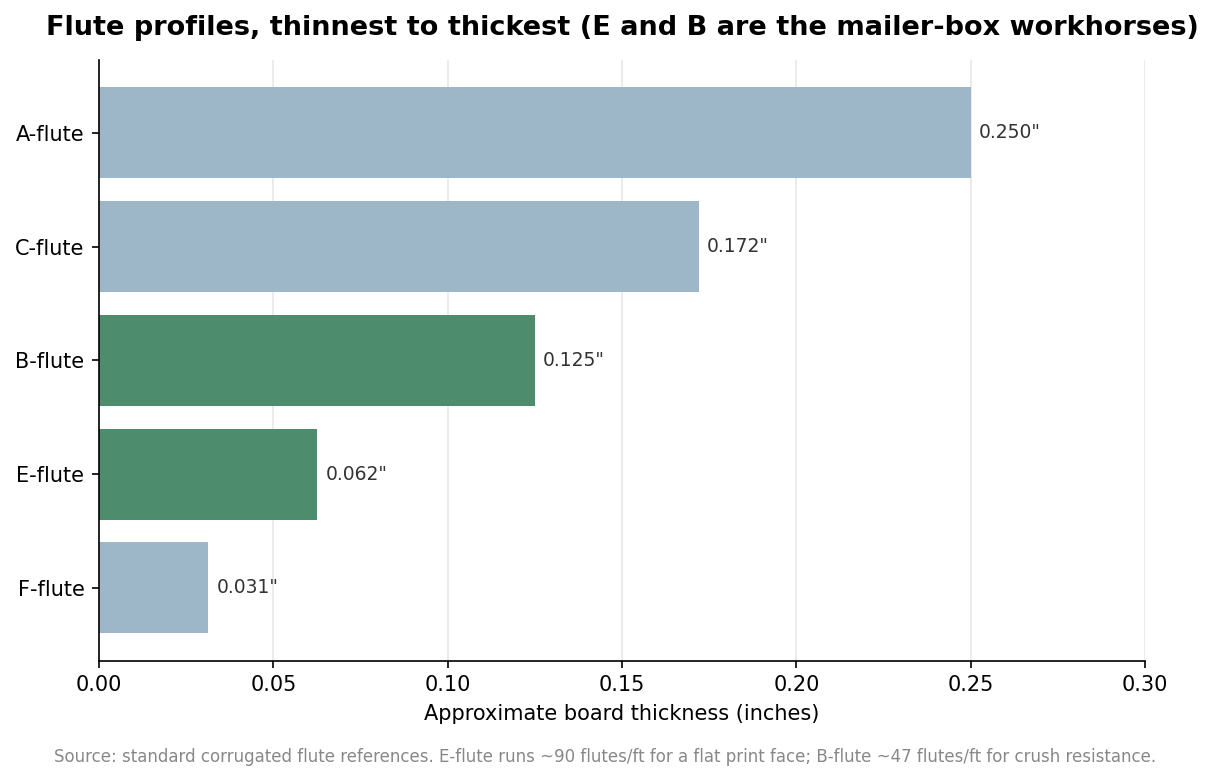
    Corrugated board is rated by its flute, the wavy fluting glued between the liners. For mailer boxes the choice almost always comes down to E-flute or B-flute. E-flute is thin, about a sixteenth of an inch, with a tight wave of roughly ninety flutes per foot. That tight profile gives an exceptionally flat outer face, which is why it prints cleanly and resists the washboard rippling that shows up when you run detailed graphics over a coarser board. B-flute is thicker, about an eighth of an inch at roughly forty-seven flutes per foot, trading some print smoothness for more cushioning and puncture resistance. The thicker A- and C-flutes are shipping-carton territory, and F-flute is thinner still and meant for folding cartons rather than shipping.

    Horizontal bar chart comparing corrugated flute thicknesses for A, C, B, E, and F flutes in inches
    E-flute and B-flute are the two profiles most mailer boxes are built from.

    For most retail and subscription work, E-flute is the default, because the graphics carry the brand and the products are light. When the contents are heavier, have hard corners, or need to shrug off rough handling and stacking, B-flute or a double-wall build earns its extra cost. If you genuinely cannot decide, a short paid sample run in each board tells you more than any spec sheet, since you can drop them, stack them, and photograph them.

    Match strength to weight and route

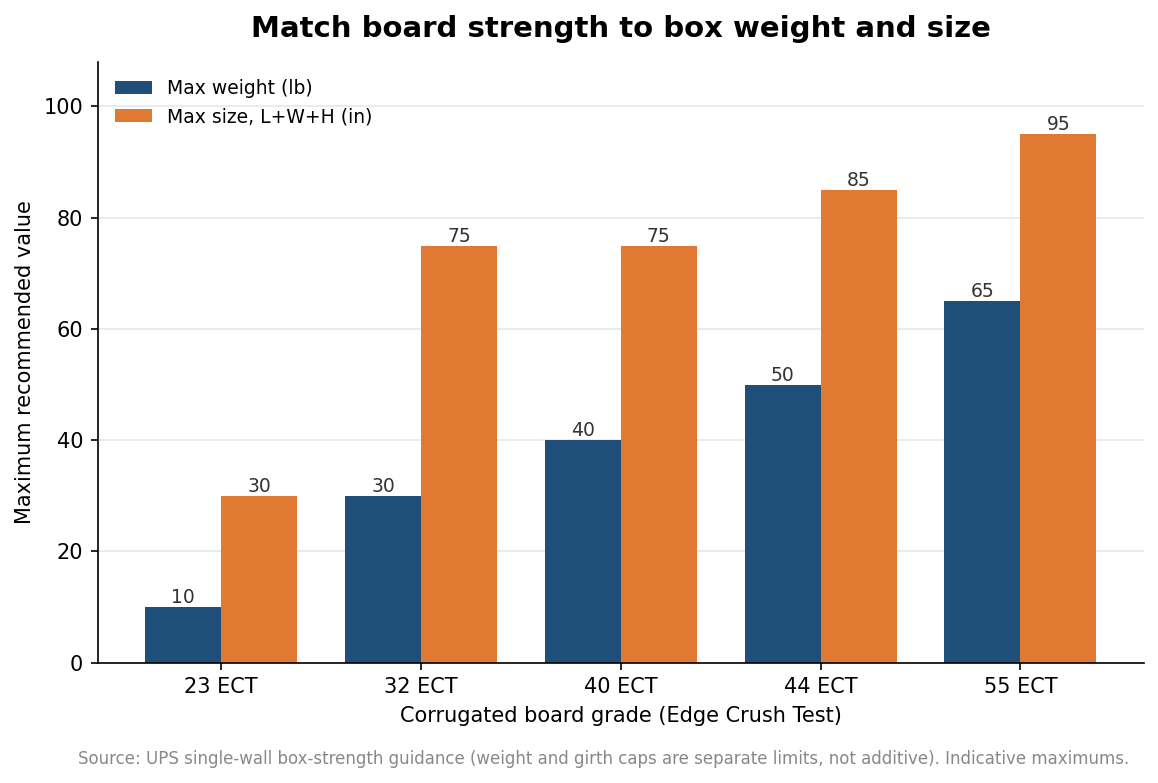
    Board strength is measured two common ways. The Edge Crush Test, or ECT, measures how much stacking force the board withstands on edge, and the older Mullen or bursting test, often quoted as a pound rating, measures resistance to puncture. As a rough field guide drawn from carrier recommendations, a 23 ECT single-wall board suits packages up to about ten pounds, 32 ECT handles up to roughly thirty pounds, 40 ECT up to about forty, 44 ECT up to around fifty, and 55 ECT up to about sixty-five. Those same grades carry size ceilings too, expressed as length plus width plus height, climbing from about thirty inches at the low end to the ninety-inch range at the top.

    Grouped bar chart of corrugated board grades from 23 to 55 ECT showing maximum recommended package weight and maximum box size
    Board strength scales with both the weight and the girth a box can safely carry.

    Treat the weight cap and the size cap as separate limits rather than one combined rule, and step up a grade when a box will be stacked on a pallet, ride a conveyor sortation line, or carry anything with sharp edges. The figures above are indicative maximums for typical single-wall board, not guarantees; your product’s fragility, the carrier, and how the boxes are palletized all shift the real ceiling. When in doubt, the cheapest insurance is testing a filled box the way it will actually ship.

    Print, minimums, and lead times

    Print method drives both quality and cost. Digital printing needs no plates, so it is the economical route for short runs and full-color interior art, and it is what most no-minimum shops use. Litho-lamination prints a sheet offset and mounts it to the corrugated for a premium, high-fidelity finish, with higher setup that pays off at larger volumes. Flexography prints directly on the board and is cost-effective for simple one- or two-color designs at scale. Minimum order quantities swing widely as a result: some digital shops start as low as a few dozen, while more traditional runs begin around three hundred to five hundred units. Production commonly runs about ten to twenty business days for custom corrugated once artwork is approved, faster for stock sizes and small digital runs.

    On budget, treat any per-unit figure as indicative and expect it to fall as quantity rises. Bulk standard mailers often land somewhere around forty cents to a dollar and a half per unit, plain kraft can run lower, and premium or luxury builds with heavy ink coverage and special finishes climb into the two-to-six-dollar range and beyond. A fitted insert typically adds something in the range of five to twenty-five percent to the box cost. Prices vary by region, board, print method, and the date you quote, so use these as planning bands and get a real quote against your final dimensions and run size before you commit. Lock the size and board first, decide the print method against your run length, and the rest of the spec tends to fall into place.