A mailer box lives or dies on two numbers you set before anything gets printed: the internal dimensions and the board grade. Get those right and the box protects the product, photographs well, and ships at a sane rate. Get them wrong and you are paying to send air, replacing crushed units, or reprinting a run because the artwork rippled across the board. This walkthrough goes decision by decision, in the order a packaging vendor will actually ask you about them, so you can hand over a spec instead of a vague idea.
What makes a mailer box its own decision
A mailer box is the folding, one-piece style with wings that tuck in and a front that locks shut, the kind that opens like a book when the customer lifts the lid. That is a different animal from a regular regular-slotted carton sealed with tape. The mailer is built to be seen: it is the first physical thing a customer touches, so the interior print, the fit around the product, and the crispness of the graphics all matter more than they would on an outer shipping carton. Because it usually travels without a second box around it, it also has to survive the carrier network on its own. That double duty — a retail surface and a shipping container at the same time — is why speccing one takes a little more thought than ordering plain cartons.
Size it around the product, not the shelf
Start with the product and any void fill or tissue you plan to include, measure it at its largest points, and add a small clearance so the item slides in without forcing. For a snug retail feel, roughly an eighth to a quarter inch of clearance on each dimension is a reasonable starting point; more if you are adding a fitted insert or crinkle paper. Remember that box specs are internal dimensions, because that is the space your product has to live in, while the board thickness adds to the outside footprint. Oversizing is the expensive mistake here. Carriers bill by dimensional weight, so a box that is an inch too big in every direction can quietly push you into a higher billable weight on every single shipment. Nailing the size down first also makes every later choice — board, print area, insert — easier to quote.
Choose the board: E-flute versus B-flute
Corrugated board is rated by its flute, the wavy fluting glued between the liners. For mailer boxes the choice almost always comes down to E-flute or B-flute. E-flute is thin, about a sixteenth of an inch, with a tight wave of roughly ninety flutes per foot. That tight profile gives an exceptionally flat outer face, which is why it prints cleanly and resists the washboard rippling that shows up when you run detailed graphics over a coarser board. B-flute is thicker, about an eighth of an inch at roughly forty-seven flutes per foot, trading some print smoothness for more cushioning and puncture resistance. The thicker A- and C-flutes are shipping-carton territory, and F-flute is thinner still and meant for folding cartons rather than shipping.
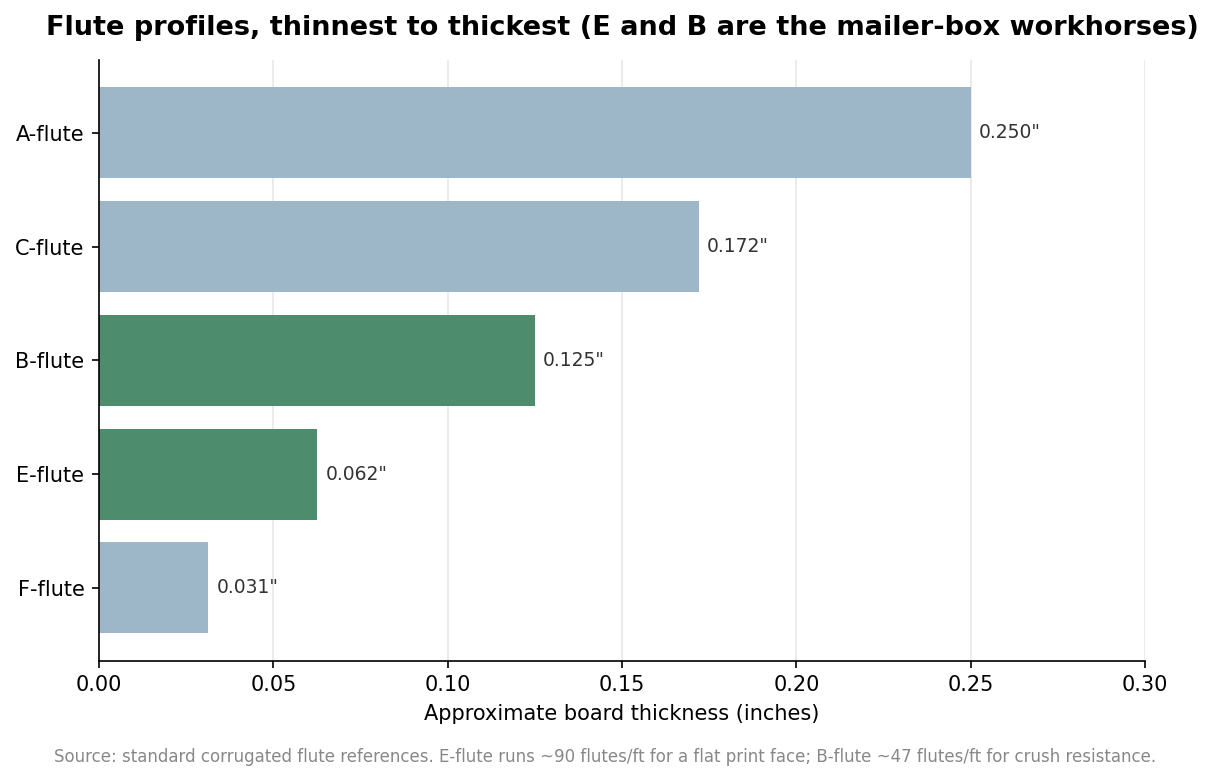
For most retail and subscription work, E-flute is the default, because the graphics carry the brand and the products are light. When the contents are heavier, have hard corners, or need to shrug off rough handling and stacking, B-flute or a double-wall build earns its extra cost. If you genuinely cannot decide, a short paid sample run in each board tells you more than any spec sheet, since you can drop them, stack them, and photograph them.
Match strength to weight and route
Board strength is measured two common ways. The Edge Crush Test, or ECT, measures how much stacking force the board withstands on edge, and the older Mullen or bursting test, often quoted as a pound rating, measures resistance to puncture. As a rough field guide drawn from carrier recommendations, a 23 ECT single-wall board suits packages up to about ten pounds, 32 ECT handles up to roughly thirty pounds, 40 ECT up to about forty, 44 ECT up to around fifty, and 55 ECT up to about sixty-five. Those same grades carry size ceilings too, expressed as length plus width plus height, climbing from about thirty inches at the low end to the ninety-inch range at the top.
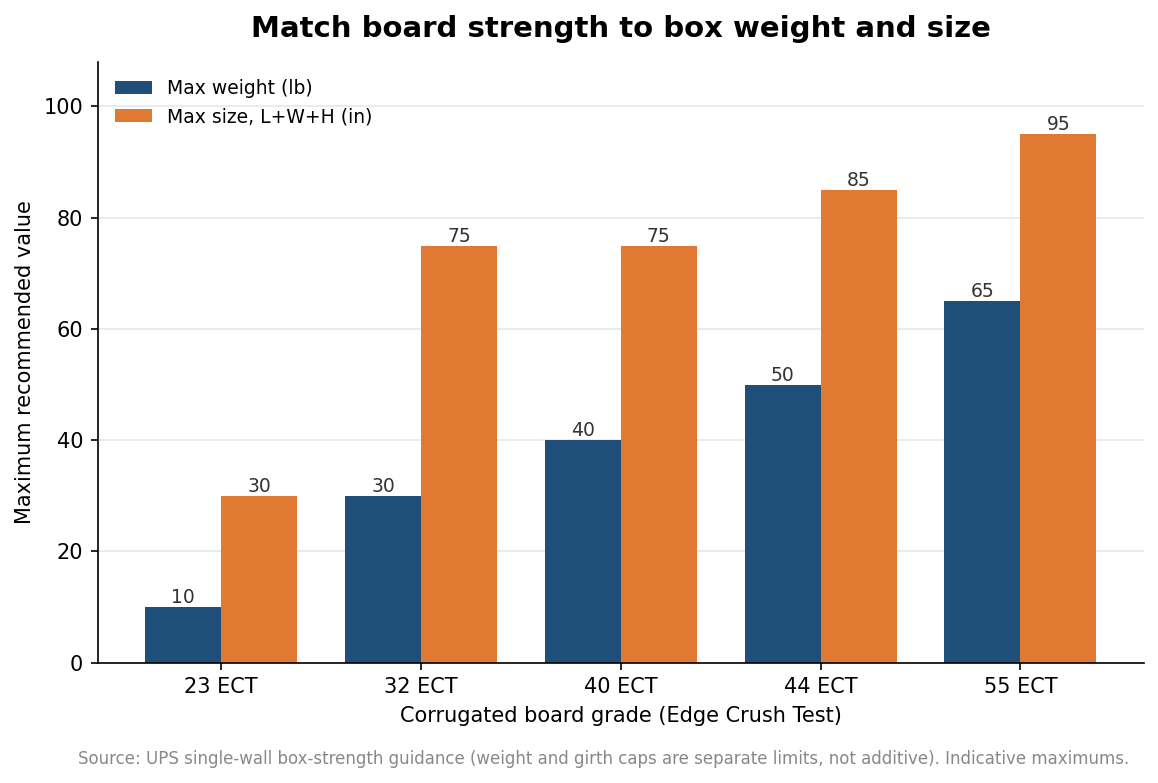
Treat the weight cap and the size cap as separate limits rather than one combined rule, and step up a grade when a box will be stacked on a pallet, ride a conveyor sortation line, or carry anything with sharp edges. The figures above are indicative maximums for typical single-wall board, not guarantees; your product’s fragility, the carrier, and how the boxes are palletized all shift the real ceiling. When in doubt, the cheapest insurance is testing a filled box the way it will actually ship.
Print, minimums, and lead times
Print method drives both quality and cost. Digital printing needs no plates, so it is the economical route for short runs and full-color interior art, and it is what most no-minimum shops use. Litho-lamination prints a sheet offset and mounts it to the corrugated for a premium, high-fidelity finish, with higher setup that pays off at larger volumes. Flexography prints directly on the board and is cost-effective for simple one- or two-color designs at scale. Minimum order quantities swing widely as a result: some digital shops start as low as a few dozen, while more traditional runs begin around three hundred to five hundred units. Production commonly runs about ten to twenty business days for custom corrugated once artwork is approved, faster for stock sizes and small digital runs.
On budget, treat any per-unit figure as indicative and expect it to fall as quantity rises. Bulk standard mailers often land somewhere around forty cents to a dollar and a half per unit, plain kraft can run lower, and premium or luxury builds with heavy ink coverage and special finishes climb into the two-to-six-dollar range and beyond. A fitted insert typically adds something in the range of five to twenty-five percent to the box cost. Prices vary by region, board, print method, and the date you quote, so use these as planning bands and get a real quote against your final dimensions and run size before you commit. Lock the size and board first, decide the print method against your run length, and the rest of the spec tends to fall into place.
Leave a Reply