Ask five packaging suppliers what a custom box costs and you will get five ranges, all of them true. The honest answer is that a printed corrugated mailer in 2026 lands anywhere from about ten cents to over four dollars per unit, and where you fall in that band is decided by a handful of levers you control: quantity, size, board grade, print method, and finish. This piece puts real published numbers on each lever so you can walk into a quote conversation knowing roughly what you should pay, instead of finding out afterward what you should have paid.
The headline bands, before anything else
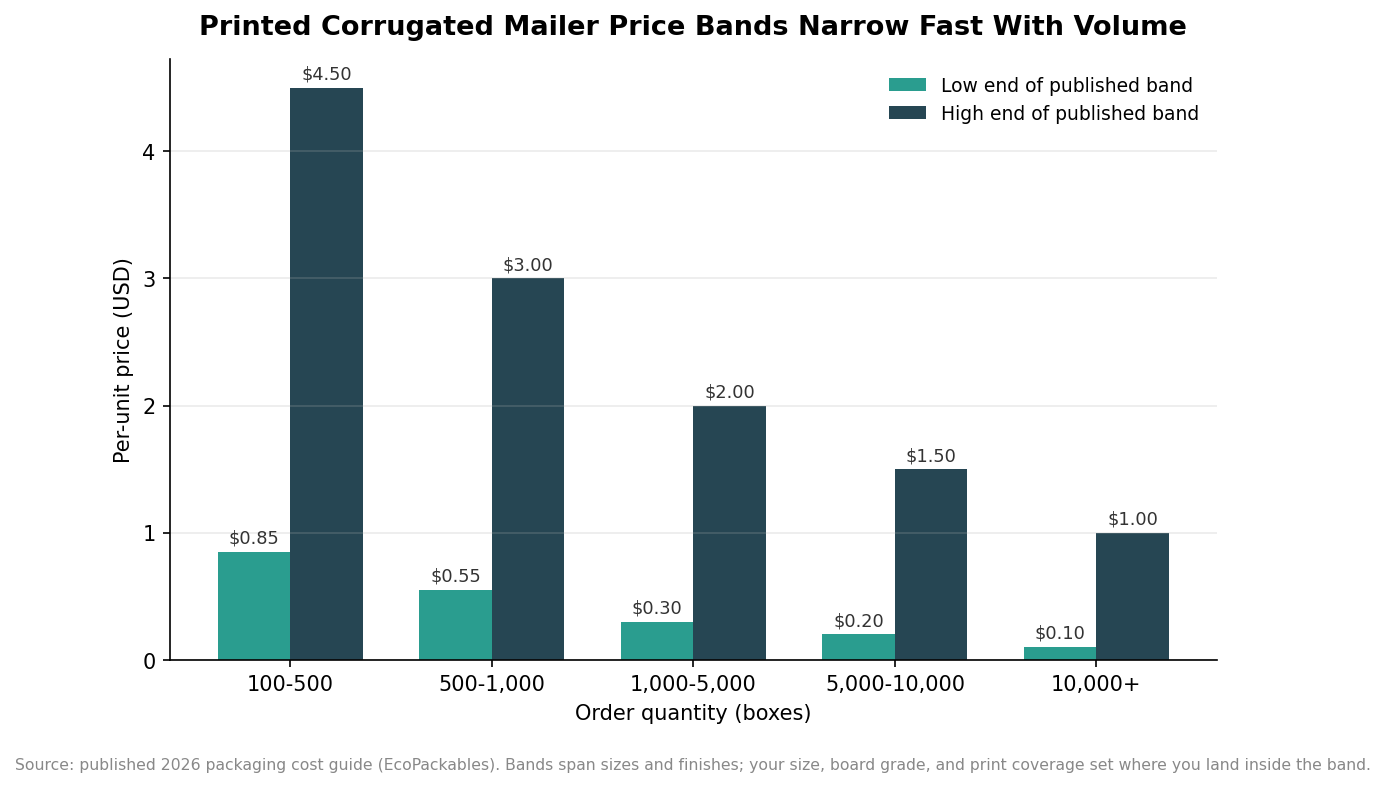
Published 2026 cost guides from US packaging suppliers converge on similar territory. Standard kraft or plain cardboard mailers run about $0.40 to $1.50 per unit in bulk, with premium fully customized boxes at $2 to $5 and up. Corrugated shipping mailers as a category are quoted at roughly $1 to $4 per box in the general case, while rigid gift-style boxes jump to $4 to $15 or more, which is why e-commerce brands rarely ship in them. Within corrugated, the published per-unit bands by volume tell the real story: roughly $0.85 to $4.50 at 100 to 500 units, $0.55 to $3.00 at 500 to 1,000, $0.30 to $2.00 at 1,000 to 5,000, $0.20 to $1.50 at 5,000 to 10,000, and $0.10 to $1.00 above 10,000. These are bands, not points, because a small kraft mailer with one print color and a large full-coverage two-side print sit at opposite walls of the same tier.
Quantity is the biggest lever, and it flattens
Read the tiers again and notice the shape: unit price falls by roughly half between the first tier and the 1,000-to-5,000 tier, then the savings per additional thousand shrink. The economics behind that are simple. Setup, plates, and machine make-ready are fixed costs spread across the run, and corrugator time gets cheaper per sheet at volume; once those fixed costs are diluted, you are mostly paying for board, and board scales linearly. The practical takeaway for a growing brand is to buy at the tier where the curve flattens for your size, typically 1,000 to 5,000 units, rather than pre-buying a year of stock to chase the last dime. Boxes are bulky to store, and a packaging redesign or a size change can strand a pallet of obsolete inventory that ate your discount.
What printing actually adds
Printing is quoted as an adder on top of the plain box, and the published figures are more modest than most buyers expect. A single color flexographic print on one side, the classic logo-on-kraft look, adds about $0.05 to $0.25 per unit. Full-color digital print adds roughly $0.20 to $0.60. Going full color on both inside and outside pushes the adder to about $0.25 to $0.80. The premium route, a litho-printed label laminated to the corrugated board for photographic quality, adds $0.70 to $1.50 per unit and is the only method here that can double a cheap box’s cost by itself.
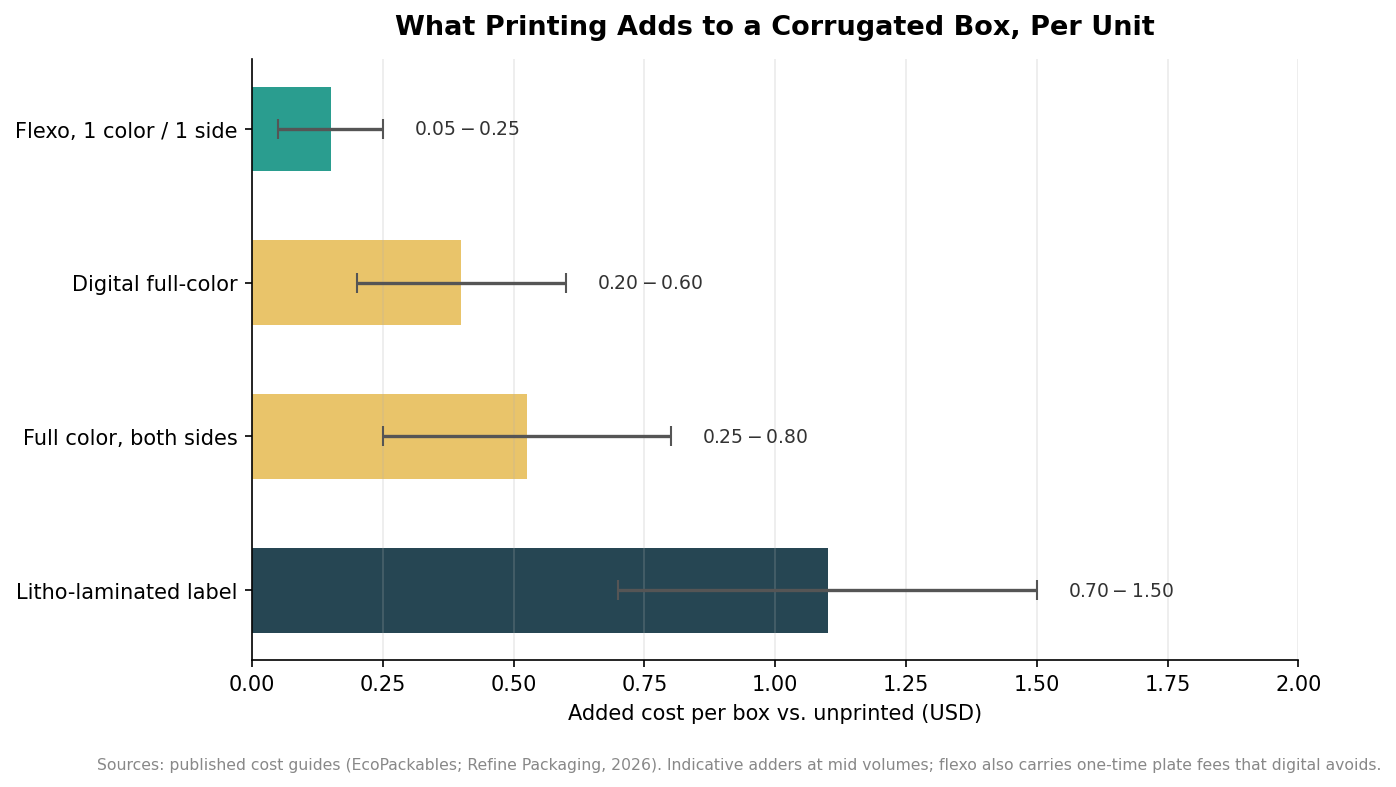
The method choice is really a quantity decision. Digital has no plates, so its unit adder is flat from the first box, which makes it the default under roughly a thousand units and for multi-design runs. Flexo carries one-time plate charges, published anywhere from $50 to $150 per color for simple stock-size work up to around $1,000 per plate for complex dedicated tooling, but its per-unit run cost is the lowest of any method, so it wins long runs of a stable design. If you print the same box all year, flexo plates amortize to pennies; if you change artwork quarterly, digital’s zero-setup economics usually beat flexo’s cheaper ink.
Setup fees, minimums, and lead times
Three quote-sheet lines deserve as much attention as unit price. First, tooling: beyond print plates, a custom die-cut shape needs a cutting die, another one-time charge, which is why sticking to a supplier’s existing die library for standard mailer sizes saves real money on small runs. Second, minimums: custom-printed work on stock sizes commonly starts at 500 to 1,000 units at traditional converters, while digital-first online suppliers advertise minimums down to low double digits or none at all, at a correspondingly higher unit price. Third, time: published production timelines run about 8 to 10 business days after proof approval, but the full cycle including sampling, revisions, and freight is realistically three to ten weeks, and overseas production sits at the long end. If your launch date is fixed, the calendar is part of the price, and rush surcharges or air freight can erase a per-unit saving overnight.
Getting to the low wall of your band
You cannot choose your price, but you can choose which wall of the band you sit against. Size down honestly: board is priced by area, and the dimensional-weight math covered elsewhere on this site means an oversized box costs you twice, once at the converter and again at the carrier. Keep the board grade proportionate to the product; a 32 ECT single-wall mailer handles most e-commerce parcels, and specifying heavier board than the product needs is the most common silent overspend. Print one color on kraft unless the unboxing is genuinely part of your marketing, in which case spend the digital adder on the outside and leave the inside plain. Quote the same spec at two quantity tiers and at two suppliers, one digital-first and one traditional, because the crossover between them depends on your exact artwork and volume. And treat every number in this piece as indicative: resin, linerboard, and freight indexes move year to year, and a published band is a map, not a quote. The map is enough to know when a quote is fair, and that is the negotiating position that actually saves money.
Leave a Reply