A custom shipping box can look perfect on the design proof and still arrive crushed. The gap between the two is testing. Carriers, marketplaces, and your own warehouse each put a box through a different kind of abuse, and a box specified for one of them is not automatically ready for the others. Before you approve a board grade or sign off on a first run, it is worth knowing exactly what your box is being asked to survive and how the common benchmarks translate into numbers you can specify.
The three tests your box actually has to pass
Most shipping boxes are judged against three separate demands. The first is the trip itself: the drops, vibration, and stacking a parcel meets moving through a small-parcel network like UPS, FedEx, or a postal service. This is what the ISTA 3A protocol is built to simulate. The second is marketplace certification, most visibly Amazon’s Ships In Own Container and Frustration-Free Packaging programs, which lean on the ISTA 6-Amazon test suite. The third is static load: the weight of identical boxes stacked on top of each other on a pallet or in a warehouse rack, which comes down to board grade more than anything else. A box can be strong in one dimension and weak in another, so it helps to treat these as separate questions rather than a single pass or fail.
Reading board grades: ECT versus Mullen
Every corrugated box carries a strength rating, and there are two competing systems. The Edge Crush Test (ECT) measures how much top-to-bottom pressure the board can take before the walls buckle, which is the number that matters for stacking. The Mullen or burst test, written as a pound figure like 200#, measures resistance to a puncture or rupture, which matters more for rough single-package handling. The two are not directly convertible, but the industry treats certain grades as roughly equivalent for everyday use.
As a working reference, a single-wall 32 ECT box, commonly treated as the equivalent of 200# Mullen, is generally rated for a gross weight in the neighborhood of 65 pounds per box. Stepping up to 44 ECT pushes that indicative capacity toward 95 pounds and improves stacking, and a double-wall 48 ECT box moves it to roughly 120 pounds for heavy or fragile goods. Treat these as starting points rather than guarantees: the real limit depends on flute profile, box dimensions, how the load is distributed inside, and humidity, which can strip a meaningful share of compression strength from any board over time.
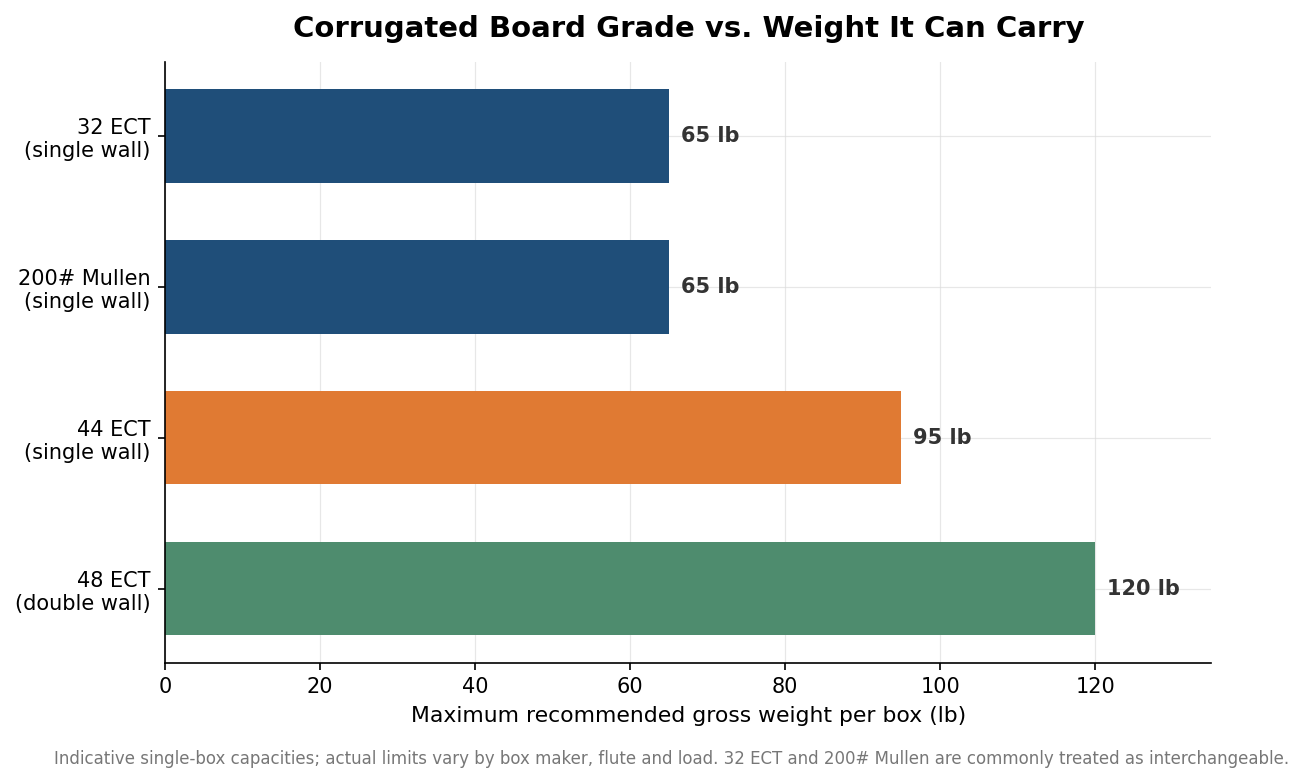
For most e-commerce products under about 20 pounds, 32 ECT single-wall is the default and the cheapest sensible choice. The case for upgrading is not simply weight but stacking depth and travel distance. If your boxes will sit five or more layers high in a warehouse, ship internationally, or carry anything dense, the extra board usually costs less than the damage claims and reships it prevents.
What ISTA 3A puts a parcel through
ISTA 3A is the general simulation for individually packaged products weighing 150 pounds or less moving through a parcel network. It is not a single drop; it is a sequence of blocks. The package is first conditioned to a set temperature and humidity, then run through two drop sequences totaling roughly seventeen impacts whose heights scale with the package weight, so a light parcel is dropped from higher than a heavy one. Between and after those drops it faces random vibration profiles that stand in for hours on a truck bed, tested both with and without a top load pressing down.
Layered on top are fixed hazard impacts that do not change with weight. Flat and elongated packages get a rotational edge drop from about 200 millimeters, and a concentrated or bridge impact where a hazard box is dropped from roughly 400 millimeters onto the package. Those two numbers, about 7.9 and 15.75 inches, are worth picturing because they represent the sharp, localized hits that expose weak corners and unsupported spans inside a box.
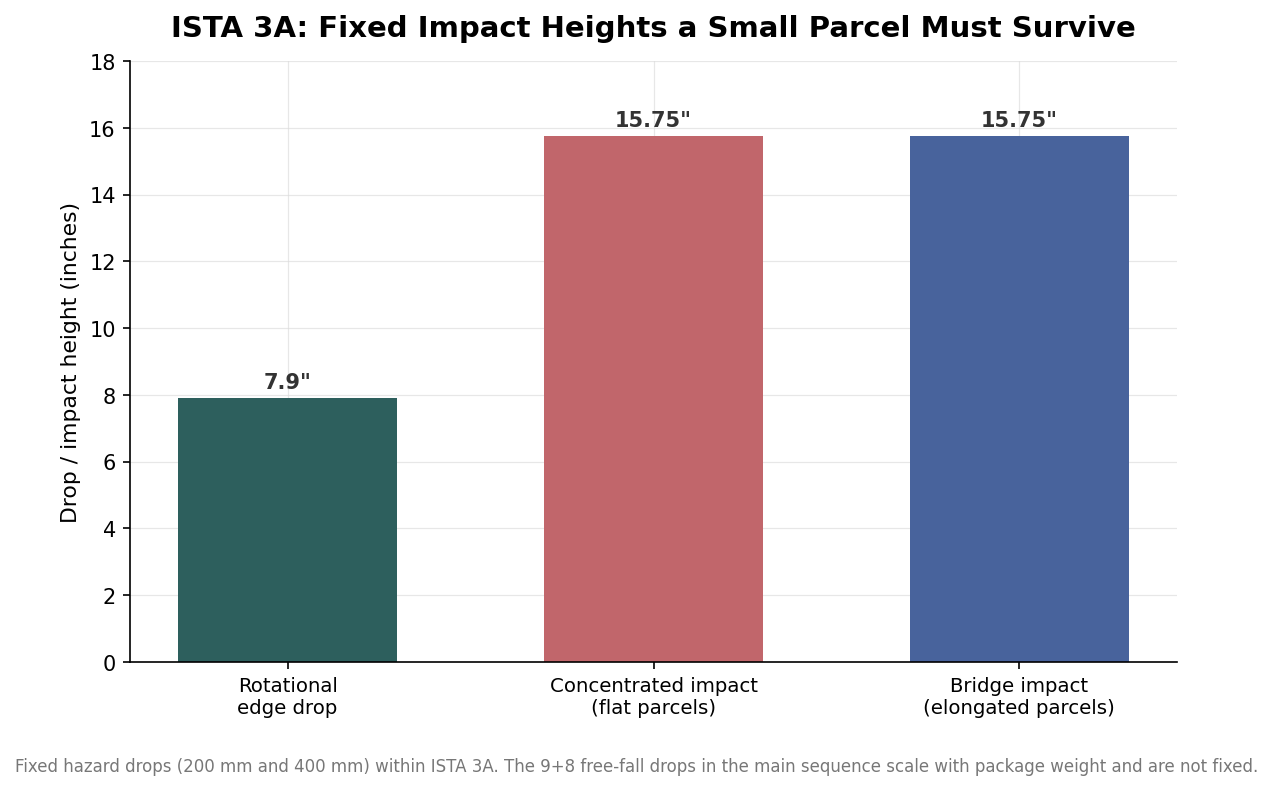
The practical lesson from an ISTA 3A profile is that internal fit matters as much as the board. A product that slides, a void that lets contents shift, or a corner with no cushioning will fail vibration and edge-drop stages even in a strong box. Right-sizing the box to the product, and adding a molded insert or dunnage where the contents are fragile, does more for survivability than jumping a board grade.
Amazon SIOC and Frustration-Free Packaging
If you sell on Amazon, the box is doing double duty as the shipper. The Ships In Own Container (SIOC) and Frustration-Free Packaging (FFP) programs let a product ship in its own branded box with no additional Amazon overbox, which cuts material and dimensional-weight cost, but the box has to earn it by passing ISTA 6-Amazon testing. Packages generally need to clear a minimum footprint of about 9 inches long by 6 inches wide by 0.375 inches high to qualify. The testing burden scales with fragility: a product deemed non-fragile can certify on a single tested sample, while anything containing glass, other easily broken materials, or liquids is treated as fragile and requires five samples of each format to pass.
The reason this is worth planning for early is that certification shapes your artwork and structure, not just your board. A SIOC box carries shipping labels directly, so the design has to leave clean label real estate, survive tape and scanning, and hold up without the protection of a second carton. Designing for it after the fact usually means a reprint.
How to specify a box that passes the first time
Start from the heaviest and most fragile item the box will carry, not the average one, and pick a board grade with headroom above that gross weight rather than right at the rated limit. Match the internal dimensions to the product so there is little void to fill, then decide cushioning based on how the contents behave under vibration rather than how they look on a bench. If a marketplace program is in your future, design the artwork around label space and certification from the first proof. And where you can, ask your box maker for the box maker’s certificate printed on the flap and, for anything headed into a marketplace or a demanding retail channel, a documented ISTA result rather than a verbal assurance. Those figures are indicative until your specific product is tested, but specifying against them from the start is what keeps a good-looking box from becoming a damaged one.
Leave a Reply